


We have launched E-mail Alert service,subscribers can receive the latest catalogues free of charge

4th NITI Aayog-DRC Dialogue held in India


 |
|
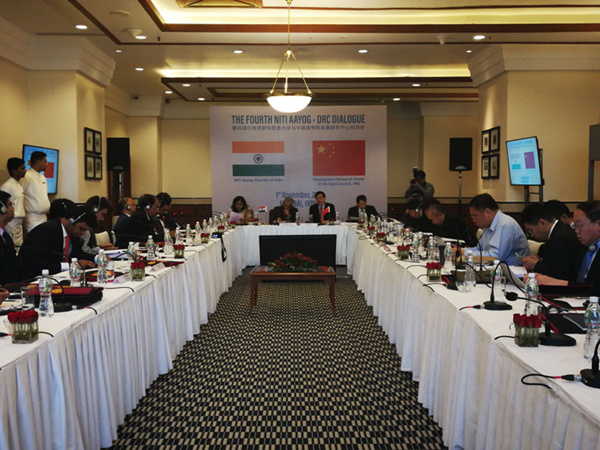
The 4th NITI Aayog-DRC Dialogue is held in Mumbai, India, on November 1. [Photo/drc.gov.cn] |
The 4th NITI Aayog-DRC Dialogue was held in Mumbai, India, on November 1.
Li Wei, President of the Development Research Center of the State Council (DRC), and Rajiv Kumar, vice chairman of the National Institution for Transforming India (NITI-Aayog), attended the opening ceremony and delivered speeches. Long Guoqiang, Vice-President of DRC, and Rajiv Kumar made the concluding remarks.
The meeting focused on the topics of "the global economic situation and China-India macroeconomic policy", "innovation, open development and economic transformation" and "the potential and prospects of China-India economic and trade investment cooperation".
In his speech, Li pointed out that the current era is facing both unprecedented opportunities and challenges. On the one hand, prosperity, stability and sustainable development are the common goals of the governments and people of all countries. The concept of open cooperation and mutual benefit is deeply rooted in the hearts of the people. The consensus on building shared global governance is the consensus of most countries, especially developing countries. Peace and development remain the themes of the times. On the other hand, hegemony and "reverse globalization" have impacted the international order and the global governance system.
Li said that China and India are the two largest developing countries, a huge market with a population of 2.6 billion, and an important engine for the development of the world economy. China and India should seize the opportunity of a new round of technological revolution-driven changes in production methods and in the division of global industrial labor, and promote sustainable and high-quality economic development. The two countries should work together to safeguard global multilateral trade mechanisms, guard against international economic and financial risks, and make due contributions to building a stable, developing and prosperous world.
First, they should deepen pragmatic cooperation in trade and investment. The economic structure of the two countries is quite different but complimentary. China's industrialization level is relatively high, and it is generally in the middle and late stages of industrialization. India has advanced software, medicine and other service industries, and the two countries can use their respective comparative advantages to promote trade and investment cooperation.
Second, it’s necessary to share scientific and technological revolution opportunities. China and India should strengthen in-depth cooperation in innovation, strengthen exchanges of talents, and promote cooperation between enterprises, universities and scientific research institutions.
Third, they should jointly defend the global multilateral trading system, promote the reform of the global governance system and the construction of an open world economy, and work together to address other global challenges.
Fourth, development knowledge should be shared. The Chinese and Indian governments and think tanks must exchange research outcomes in poverty alleviation, early childhood development, education and medical care, industrialization, urbanization, digital economy, industrial transformation and upgrading, service industry development, park construction and environmental governance. There is a need to share development knowledge and jointly promote the implementation of the 2030 Agenda for Sustainable Development.
Rajiv Kumar said in his speech that China and India, as the two fastest growing emerging economies in recent years, have played a pivotal role in the global economy. The DRC and NITI-Aayog, as important think tanks in China and India, have carried out frequent and constructive dialogues, which helped the two countries carry out more cooperation in economic and social fields.
At present, the global economy faces many shocks and uncertainties. Attention must be paid not only to the hardships of developed countries, but also to the pain of emerging economies. Emerging economies such as China and India are different from the United States and the developed countries of Europe, and need to deal with different types of challenges. In order to reach the common goal of maintaining healthy and rapid economic development, China and India need to work together to build a platform for multilateral economic and trade cooperation. Other emerging economies in Asia and Africa are welcomed to join this mechanism and create a bright future with new technologies.
 |
|
The 4th NITI Aayog-DRC Dialogue is held in Mumbai, India, on November 1. [Photo/drc.gov.cn] |
In his concluding remarks, Long Guoqiang pointed out that during the dialogue, China and India exchanged views on topics of common concern. China and India have formed a consensus on maintaining free and open multilateral trade. As friendly neighbors, they have accumulated rich experience in solving development problems. The DRC and NITI-Aayog should further deepen exchanges and cooperation, give play to their respective advantages, carry out joint research, and make suggestions for the development of both countries.
The Chinese and Indian experts attending the event discussed the world economic situation, and development opportunities and challenges faced by the two countries. They analyzed the causes of the trade imbalance between them and the potential for future cooperation, putting forward many suggestions. The two sides formed a consensus on jointly defending the global multilateral trading system and increasing bilateral economic and trade investment cooperation.
After the dialogue, Chinese Ambassador to India Luo Zhaohui met with Li’s delegation and congratulated it on the success of this event. Luo spoke highly of two joint research projects on WTO reform and urbanization negotiated at the event.


