
Arts and traditions
The Heroic Epic of Gesar (ICH)
Updated: 2013-10-29( chinaculture.org )
The first?list of Intangible Cultural Heritages was approved by the nation in 2006.
Year: 2006
Sort: Folk Literature
Area:Inner Mongolia,Sichuan province,Yunnan province, Tibet,Gansu province,Qinghai province, and Xinjiang Uygur autonomous region
Serial No.: Ⅰ-27
Declarer: Tibet, Inner Mongolia, Sichuan province, Yunnan province, Tibet, Gansu province, Qinghai province, and Xinjiang Uygur autonomous region, The Gesar Study Office of Chinese Academy of Social Sciences
King Gesar is a heroic Tibetan epic. Originating from oral folk traditions, King Gesar was passed down through generations in a combination of song and narration for over 1,000 years. So far, King Gesar has been collected in more than 120 volumes, with more than one million verses (over 20 million words) -- 25 times the length of the Western classic, Homer's Iliad. King Gesar, the greatest work of Tibetan literature, is easily the longest epic in the world, which has also appeared in ballads among the Mongols and Tus.
King Gesar of the Ling Kingdom was born in the 11th century as the son of the supreme god Indira. As a boy, he was very mischievous, but divine by nature and full of supernatural powers. His greatest enemy was his uncle, who was a cowardly, vain and pretentious man who hoped to rule the country. Although the hero and his mother were banished, Gesar's exile enabled him to nurture his hidden strengths. He emerged victorious in a horse race to become king of the nation. King Gesar then began conquering the "kingdoms of demons" -- the Jiang and Hor (northern Mongolian) kingdoms. The war between the Ling and Hor kingdoms constitutes one of the central parts of the story. It began with a beautiful girl, Qomu, who was King Gesar's queen. The Hor king, also known as the "White Tent King," heard about her beauty and sent for her. When his request was refused, he sent troops to attack the Ling kingdom. After several battles, another girl was sent to the Hor king in the place of Qomu. But once the truth was uncovered, the battles resumed. The Ling capital, along with Queen Qomu, was finally captured by Hor troops. But King Gesar organized all his troops with the help of an important Hor general, captured the Hor capital, killed the White Tent King and rescued his queen.
King Gesar originated from ancient Tibetan society and has a deep grounding in ancient Tibetan literature, especially folk tales. Before the epic emerged, Tibetan literature boasted a numerous variety of richly woven works, especially folk and fairy tales, legends, traditional stories and poems. King Gesar drew much from previous literary works and carried forward the tradition of excellence via plot development, evolution, materials, and forms of expression, as well as ideology, religion and customs. The epic also borrowed a number of Tibetan proverbs that were cited in the original work or adapted later in the epic.
In Tibetan- areas Gesar was known as the king of the ancient Tibetan kingdom of the Ling. The great hero and his brave army are kept alive in the rich, imaginative retellings of the epic.
Gesar's image and story are immortalized in carvings, paintings, murals, woodcuts, embroideries, songs, dances and plays. Whether hero or tyrant, male or female, young or old the characters make a deep impression on readers with their clearly defined features and striking images. The heroic figures, led by King Gesar, provide immortal examples of valiant sacrifices. No two figures in the epic are identical.
By using verse, prose, lyrics and narration, the epic combines real stories, myths, poems, fables, proverbs and mottoes, making it an eclectic collection of Tibetan folk culture.
From early times, the epic was passed on orally. Today, a small number of inscribed woodblocks of the epic can be found inLhasa, Xigaze and Dege county in Sichuan Province; a few handwritten copies have also been found among some families. The Potala Palacecontains a statue of Gesar, which still attracts pilgrims on a daily basis. Gesar's deeds were recorded in the Kangba region more than anywhere else, and handwritten and printed versions of Gesar from Dege are considered the most authoritative works. People still argue that the village of Ngaxu in Northern Dege county was the birthplace of Gesar.
 |
| King Gesaris a heroic Tibetan epic. Originating from oral folk traditions, King Gesar was passed down through generations in a combination of song and narration for over 1,000 years. |
 |
| King Gesaris a heroic Tibetan epic. Originating from oral folk traditions, King Gesar was passed down through generations in a combination of song and narration for over 1,000 years. |
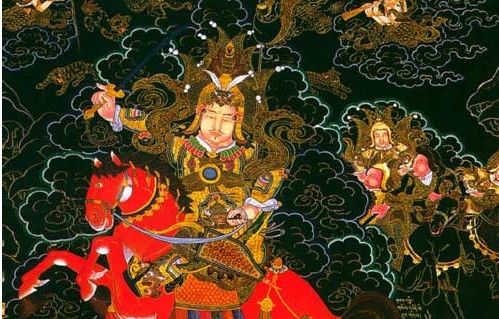 |
| King Gesaris a heroic Tibetan epic. Originating from oral folk traditions, King Gesar was passed down through generations in a combination of song and narration for over 1,000 years. |
 |
| King Gesaris a heroic Tibetan epic. Originating from oral folk traditions, King Gesar was passed down through generations in a combination of song and narration for over 1,000 years. |
News


