|
China has a long history in porcelain, which developed from pottery making. The ceramic history can be traced back to the Neolithic age. Along with the development of ceramics,in the early period of the Shang dynasty (1783-1134 BC), the original green porcelain, or celadon, appeared.
The Song Dynasty (960-1279) was a boom period following the Han and the Tang dynasties, when porcelain kilns were spread in the whole country, with different strong local flavors.
The "Five Famous Kilns", including the Guan Kiln, Ru Kiln, Ge Kiln, Ding Kiln and Jun Kiln, are most famous.
Guan kiln
In Chinese, "Guan" means the government. The Guan Kiln was the government kiln that only produced fine porcelains for the royal family and court.
Classified into the Northern Song Guan kiln in Bianjing (today’s Kaifeng city of Henan Province) and the Southern Song Guan kiln in Hangzhou in south China’s Zhejing Province, according to different Dynasties, the Guan kilns are boasted as the finest celadon porcelain. Strong and smooth roughcast, clear and shining glazes were characteristic of the Northern Song Guan Kiln's porcelains. And the Southern Song Kiln's porcelains had light green, gray or yellow glazes.
Usually there were many cracks on the surface. The upper rim of the porcelains had a purplish color while the lower rim had a dark iron color. This was called "the purple mouth and iron foot."
The main products are the bowls. Plates, bottles and washing vessels, most of them are in a simple and elegant style.
Jun Kiln
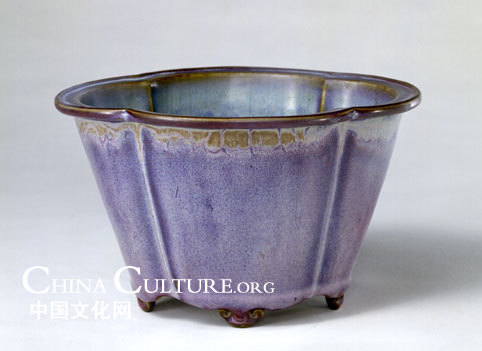
Jun Kiln was located at today’s Baguadong (Eight Diagram Cave) in Henan Province. The glaze color of the Jun porcelains was usually sky-blue or moon-white. But the Jun Kiln also created a very special copper red. The copper red color was a product of a special procedure called the furnace-transmutation. The Jun Kiln used the copper-rich glaze to cover the roughcasts. The copper was very sensitive to variations in kiln conditions. A tiny change of temperature would a create totally different color.
The copper red was treasured by the Song nobles. Other colors such as violet or peach pink were also very popular. The changing color on the porcelain vessels formed different natural pictures: some like mountains in the mist, some like green bamboo, and some like waterfalls in the valley. Some scholars called it "one color into the kiln and ten thousand colors out of the furnace."
|