Mausoleum of the Ming Emperor
( chinadaily.com.cn, zgmxl.com )
|
|||||||||


5. Curved imperial river
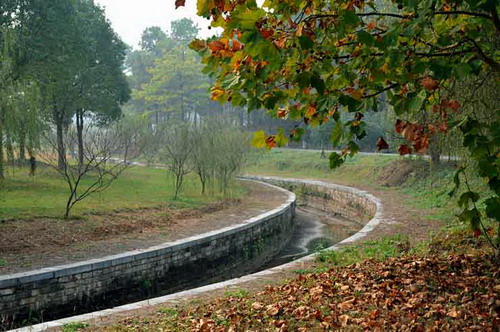 |
| Curved imperial river |
The imperial trench is referred to by local people as the curved imperial river because its form explicitly incorporates the geomancy intention of “curve in shape.” It served as the main drainage facility for the Xianling mausoleum. Although Ming mausoleums paid attention to drainage and flood discharge in mausoleum areas, they also employed dig up trenches or utilized natural rivers for drainage. The trench of Xianling mausoleum, however, differed from that of the other seven mausoleums due to its perfect drainage system and incarnation of geomancy theory. It has become a key element of the characteristic cultural relics and tourism resources of Xianling mausoleum.
6. Inner and outer ponds
 |
|
The resplendent and magnificent outer pond, made of red walls and yellow tiles, winds around the 3,600 meter perimeter in the mountain range. |
During the planning of Xianling mausoleum, inner and outer ponds were designed according to geomancy theory. It is believed to be the result of Emperor Ruizong and Emperor Shizong’s Taoist beliefs.
Mingtang, or bright ponds, are homophonic of bright halls. Bright halls are important concepts of the geomancy theory. Bright halls originally mean an open clearing of the mausoleum, close to the core. To deflect wind and gather qi, the inner bright hall should not be too wide. The outer bright hall sits near the outer wall and must be for the sake of long-term development.
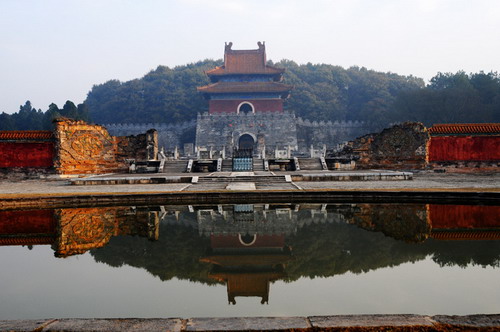
The inner bright hall is placed before the main gate, with a pond set in an open square. Xing Du Record and Cheng Tian Great Record termed it as the “inner bright pond.” There is an outer bright pond in the central axis to the south of the old red gate. The inner and outer bright ponds are set up only in Xianling mausoleum. No other Ming mausoleums follow that pattern.
 |
|
The inner bright hall is placed before the main gate, with a pond set in an open square. |
7. Dragon-shaped deity lane
Xianling mausoleum is the only mausoleum of Ming emperor tombs keeping the tradition of the integral dragon-shaped deity lane with dragon scales. The slab stone paved in the middle is referred to as “dragon spine.” It is filled with cobblestones at both sides, known as “dragon scales.” Stones are paved around the sides to make the dragon-scale lane. The practice meets the functions of the mausoleum architecture and economical. It displays the wisdom of the ancestors and supplied the material basis for deity lanes of other mausoleums of Ming dynasty.
 |
|
Xianling mausoleum is the only mausoleum of Ming emperor tombs keeping the tradition of the integral dragon-shaped deity lane with dragon scales. |
8. New red gate and old red gate
The new red gate is the door of the outer wall, marking the entrance to Xianling mausoleum. It is also an important sign showing that Xianling was promoted from a prince mausoleum to an emperor mausoleum. In contrast to the new red gate is the old red gate. The old red gate is the doorway of the mausoleum when it was once a prince tomb. It is rare in ancient Chinese traditional architectures that the new and old red gates are not in the same central axis. Nonetheless, Xianling is a good example of Chinese mausoleum architecture culture from the Ming dynasty that harmonized mausoleums with the landscape.
 |
| The new red gate and old red gate |