Wudang Mountain
( chinadaily.com.cn )
|
|||||||||


Wudang Mountain, in the northwest of Hubei province, is perhaps the best known of China's Taoist holy mountains. It was listed by UNESCO as a World Cultural Heritage Site in 1994.
The mountain has several main tourist attractions, covering an area of 300 square kilometers. From afar, the scenery resembles a beautiful, traditional Chinese landscape painting.
Wudang Mountain is famous for its perfect combination of natural and cultural scenery. It is also renowned for its magnificent ancient buildings, profound traditional Taoist culture and Wudang kungfu.
Natural beauty

Wudang Mountain is beautiful all year round. In spring, the area is filled with flowers; in summer, the mist envelops; in autumn, oranges turn yellow and the smell of sweet-scented osmanthus fills the air; in winter, heavy snow covers the mountain like a white blanket.
Tianzhu Peak, the main peak, 1,612 meters above the sea level, is just like a?pilar supporting the sky. Around Tianzhu Peak are 72 peaks, 36 rocky cliffs, 24 streams, three pools, nine springs and 10 lakes.
Wudang Mountain has rich plant resources. About 600 of the 1,800 medicinal herbs recorded in Compendium of Materia Medica compiled by the Ming Dynasty (1368-1644) scientist Li Shizhen can be found in the area.
Ancient building complex
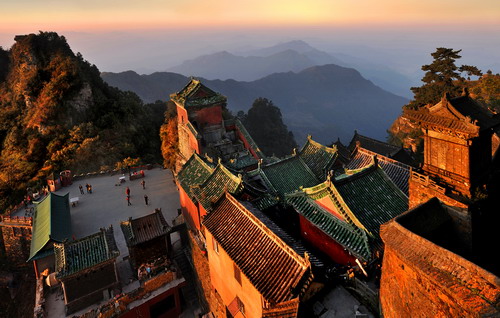
A sprawling ancient building complex in the Wudang Mountain was founded in the heyday of the Tang Dynasty (AD 618-907), but reached its zenith during the Ming Dynasty, when Emperor Zhu Di sent some 300,000 workers in 1412 who spent 12 years to finish the sacred site.
The impetus for such imperial glamour originated in legends that say the prince of Pure Pleasure State came to Wudang Mountain to nurture his will and power. He has been worshipped ever since. Most of the buildings contain stories about him, including Pure Pleasure Palace built in the ancient city of Junzhou.
The buildings are located in a 70-km-long area from the Pure Pleasure Palace in the ancient city of Junzhou to the Golden Hall at the top of Tianzhu Peak.
At present, the well-preserved buildings include Xuanyue Archway, Yuanhe Taoist Temple, Yuzhen Palace, Yuxu Palace, Fuzhen Taoist Temple, Zixiao Palace, Taihe Palace and Golden Hall. The Golden Hall, situated on top of Tianzhu Peak and built in 1416, is the most famous of the buildings.
The complex was designed to fit the Taoist principle of harmony between man and nature. Its buildings are cited as a museum of ancient Chinese design and thought. A thousand years of lightning, storms and winds only make them more magnificent.
The buildings have won wide acclaim in architectural circles. Two United Nations experts wrote that they think the Wudang Mountains are among the beautiful places on earth due to its exquisite architectural design.
Taoist culture

Taoist ritual activities follow a set of procedures handed down through generations of Taoist priests. The priests recite ancient scriptures and play Taoist music, following a centuries-old formula. Taoist music has been extensively studied by scholars and experts.
Wudang kungfu

(Photo by Yang Guangzhi)
Wudang kungfu, as a culture, took root in the fertile soil of the thousand-year-old Chinese civilization, and contains profound Chinese philosophical theories combined with the traditional notions of Taiji (shadow boxing), Eight-diagram and Xingyi, converted into boxing theories and skills.
Influenced by the Taoist idea of "self-protection and self-cultivation in isolation", the skills of Wudang kungfu are characterized by not taking the initiative in an attack, as "removing is fighting, and fighting is removing".
Crouching Tiger, Hidden Dragon, an action film directed by Ang Lee in 2000, attracted students of kungfu to travel from all over the world to study with the masters at Wudang. Lucky visitors may be able to see masters practicing on the roofs of halls and on the mountain.
It is said that the father of Wudang Internal Kungfu is Zhang Sanfeng. In the Ming Dynasty (1368-1644), he created the Wudang Sector on the basis of the theory of alchemy. According to legend, Zhang Sanfeng was inspired by a fight he witnessed between a pied magpie and a snake.
Yuzhen Palace is the cradle of Wudang kungfu. In 1417, Emperor Zhudi decreed Wudang to be the "Grand Mountain" and ordered the construction of the Yuzhen Palace for Master Zhang Sanfeng.
On January 19, 2003, a fire broke out in the hall, reducing the three rooms that covered 200 square metres to ashes. A gold-plated statute of Zhang Sanfeng, which was usually housed in Yuzhen Palace, was moved to another building just before the fire, and so escaped destruction in the inferno.