 |
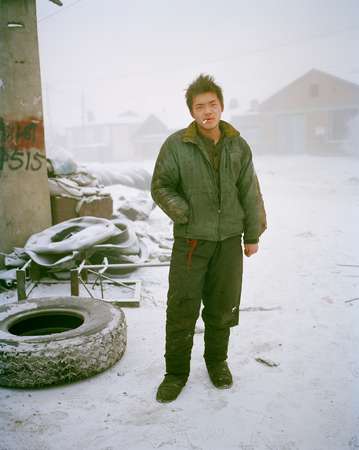
| Young artist You Li's work on display at the Lianzhou festival. |
Located far northwest of Guangzhou, Lianzhou is a small, little-known city and definitely not a favorite destination for travelers, but winter is always an exception. Crowds of photo enthusiasts from around the world descend on Lianzhou for their annual photography festival.
Opened Friday evening and scheduled to run until December 26, the Lianzhou International Photography Festival began in 2005 and has grown into a major photography fixture. This year is even more exciting than ever, with the festival resisting pressure to expand and instead featuring meticulously-organized solo exhibitions.
"We want to offer a different angle for photography festival-goers this year, to get the chance to observe one exhibition and thus one photographer closely and thoroughly," Duan Yuting, curator and initiator of the festival, explained to the Global Times, adding that photography festivals in China are all racing to increase in size, but are failing to impress as many are disordered and poorly organized.
With the theme Is The World Real? this year's Lianzhou festival aims to explore the meaning of photography and the relationships among photographs and people behind the camera. On display are works by established international and Chinese photographers and artists including Jean Baudrillard, Patrick Zachman, Liu Xiangcheng, Zhu Xianmin and Zhang Dali.
Although as usual, master works are the highlights of the festival, sharing the limelight are a number of pieces by young photographers, many who have never received formal education in photography.
Fei Dawei, one of the curators of the event, explained that he chose some young photographers because of their freedom in taking photos, both in concept and skill.
"Through their works you can see an intimate relationship between the photos and the photographers," Fei said. "They just capture what they see and do so in a very natural way, which is of great gift for photography."
All of the solo exhibitions, almost 60 in total, are being presented at three different venues, the Shoe Factory, the Granary and the Candy Factory. All had once been deserted and offer a window into the past with their names, in a small, remote city where grain, shoe making and candy production were once the three pillar industries from ancient times to just a few decades ago.
Despite the surrounding noises and venues overcrowded with fashionable Chinese and foreign audiences, standing in the middle of the unused factories and granary still takes you easily into a feeling of nostalgia. The mottled gray walls are perfectly suitable for displaying photos that have captured past moments in life and the combination of the stark environment and captivating photographs make you feel lost in the river of time.
Photographer Zhang Wei couldn't disguise his elation when seeing his works for the first time on display inside the granary. Entering the cone-shaped structure, you are surrounded by Zhang's shots of different people, all sitting quietly with serious expressions, looking straight down the barrel of the camera.
"It is the best way to show my works, the intensity I wanted to explore," Zhang said. Like many other devoted artists, Zhang is introverted and not usually good at explaining himself in words.
His exhibition, Temporary Performers, includes shots deliberately selected from over 100 pictures of temporary performers he captured over the past two years. The usual element in his work is that he casually swapped facial features among his subjects through his computer, which resulted in all of his photos having the same facial expression: tired and frustrated.
"No matter how I placed the noses, eyes and mouths, I was shocked that they showed the same expression of frustration and tiredness," Zhang said. "I suddenly realized that these expressions are common traits of all Chinese people today."
While the festival has received much recognition, it is not without its critics. Some are questioning the level of professionalism, especially in regards to curating.
An exhibition from Shanghai-based photographer Ni Weihua, Landscape Walls, being held at the Granary, is very similar to that of French photographer Patrick Zachman's Disguised of the City being held at the Candy Factory in terms of the subjects of their photos: All reveal the rapid-development in Chinese cities with mass construction, sometimes with people in front of a beautiful billboard of a real estate development project.
"You can hardly see who copied whom, it is probably that both of them were inspired by the same subject," commented an onlooker. "It is apparently not appropriate to present the two exhibitions in one event."