 |
|||||
|
|||||
|
The trip to Xi'an is not complete without savoring the local snacks in a local restaurant. Jun Ying |
The culinary route offers one of the best ways for Xi'an's visitors to get off the beaten path. Liu Jun reports
It was nightfall when our car stopped at a small eatery off a bumpy, dusty road. My friend assured me, "This is the best place to taste Qinzhen mi pi".
He planted himself on a rickety bench and ordered two bowls each.
Mi pi is said to have wooed the First Emperor some 2,200 years ago. Legend has it that a drought ruined the year's harvest, and farmers in Qinzhen town, Shaanxi province, couldn't pay their grain taxes.
A clever man named Li Shi'er (Li the 12th) soaked old rice in water and steamed the pulp to create thin pancakes, which were sliced and seasoned with vinegar and hot pepper. It's said the First Emperor liked the creation so much, he ordered it from Qinzhen every day.
One bite of the long, broad rice noodle testified to the truth behind the folklore. The noodle was soft; the cucumber slices were crispy. Best of all was the spiciness, which made me think of the plump crimson peppers dangling from strings outside the windows to dry in the sun.
Like the other food I sampled during my recent trip to Xi'an, capital of Shaanxi province, this simple bowl of noodles brought the unique satisfaction of eating wholesome foods.
Despite the floods of tourists attracted by the Terracotta Warriors and the new skyscrapers dwarfing the city's ancient landmarks, Xi'an has maintained its profound traditional culture. Perhaps the best way to experience this is to savor dishes loved by local people but neglected by tourists.
My friends all responded with great enthusiasm, introducing me to noodles, pancakes, dumplings, steamed buns and a myriad of specialties made from rice, wheat, buckwheat - all sorts of grains. The great trouble locals take to find and prepare the best ingredients and the variety of ways they have invented to eat them is a source of wonderment.
At a restaurant serving food from Sanyuan county, Xianyang, the noodle (geda mian) is bound in three small knots and served with soup, pepper and minced meat.
Our waitress, as charming and proud as the city's other servers, patiently taught us how to mix the noodle with peppers and meat. She also told us we should drink the brine before eating the dish's solid ingredients.
Another way is rinsing the noodle with soup and then mixing it with the seasoning. And mixing everything together is yet another way to devour this delight.
From creation to consumption, this dish delights a gourmet's taste buds.
But I was most impressed by the sour soup, which must be the soul of this specialty. There is something quite unique about the vinegar that gives the soup such a mellow, sour and sweet character.
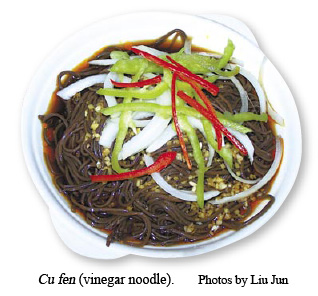
My guess was soon proven correct with a dish called cu fen (vinegar noodle, see picture on top), which is prepared using the leftovers from making vinegar. For a mother-to-be who craves sour food, this humble brownish noodle would seem heaven-sent.
A favorite joke among locals is about a pregnant woman from Beijing who took a famous restaurant's challenge and successfully cancelled her bill by devouring 88 bowls of noodles in one sitting.
That restaurant was jam-packed when we arrived. Many pictures on the walls showcased the long history of jiaotang mian (pouring-soup noodle), which originated in Qianzhou, today's Qianxian county. The county is better known for the mausoleums of Tang Dynasty (AD 618-907) Empress Wu Zetian and her husband Emperor Xuanzong.
The waitress scraped some noodle off a pan, mixed in Chinese onions, chives, fried eggs and other seasonings, and then poured in some soup that had been boiling over a stove beside our table.

The noodle is also called hanshui mian (saliva noodle) because in the past, farmers in Qianzhou couldn't afford to add fresh water to cook more noodles, so they poured the soup left in their bowls back to the pot.
But the dish's nickname could be better translated as "mouth-watering noodle". If we hadn't ordered too many dishes, I might also have won the challenge, like the pregnant woman in the local joke. The noodle bowl was smaller than my fist, and the accompanying sour soup was so helpful for digestion.
Sometimes, accidental discoveries become the best part of a trip.
One morning, we visited the downtown Shuyuanmen pedestrian street, where miniature replicas of Terracotta Warriors, shadow puppets made of donkey hide and other souvenirs are displayed next to calligraphers bent over huge desks scripting ancient classics.
We were too tired to head to the renowned Muslim snack street several blocks away. So we entered a restaurant serving roujiamo (pancakes stuffed with minced meat).
The pancake was fragrant and crispy, and the meat had a special flavor, because it was made from good pork stewed for a long time. Customers waited patiently on the streets outside the restaurant.
My gourmet friends all congratulated me for stumbling upon one of the best eateries offering roujiamo.
"If you went there after noon, the waiter would proudly tell you: 'We've sold out all our pancakes'."
Then, why can't they make more, and even sell the pancakes to other cities?
Tradition holds that the pancakes and meat made and eaten in the morning are the best. The restaurant is more concerned about maintaining quality than drawing more customers, my friends explain.
Too bad Beijing doesn't have such a fresh delicacy. But it gives me something to long for upon return.
In recent years, the booming automobile industry has allowed more Xi'an residents to visit the suburbs, giving rise to nongjiale - that is, farmers offering food and lodging to urban visitors.
We found Shangwang village at the northern foot of the Qinling mountain range. The settlement didn't look appealing, with a fake tree installed at the entrance and newly built brick houses lining the main street.
My friend finally stopped at a courtyard in a side lane, with a swing dangling in the doorway. The host, a lanky and shrewd man, greeted us like old friends. One bite of potato chips fried with pepper and vinegar completely changed my first impressions of the place.
It's hard to believe that for a lavish meal of a dozen courses, each person only pays 15 yuan ($2.20), with portions for children costing half of that. And it costs merely 45 yuan to spend a night in one of the two-story building's 20 simply furnished rooms - three meals included.
Zhao Yongqian, 42, says he was one of 10 farmers in the village to venture into the nongjiale business about six years ago. Actually, he had to quit a lucrative job in the import-export sector to return to the countryside.
Time has proven his far-sightedness. Today, about 130 local families are earning at least 100,000 yuan a year by following the early pioneers' examples.
The village has formed its own production lines: Old grannies go to the mountains to search for wild herbs; some families specialize in raising chickens and rabbits, while others take care of the kiwi and fruit orchards.
Before the financial crisis, Zhao says all his rooms would be booked a week in advance even during the low season. With his wife and a few hired helpers, Zhao can easily cater to the customers: He only needs to make a phone call to get a chicken or rabbit, which respectively cost 40 and 50 yuan. The taste is beyond description for someone who has only eaten frozen supermarket meat.
My 4-year-old son, a picky eater, squeezed an entire thin pancake the size of a handkerchief into his mouth. He didn't choke, and he went on to finish five more.
If Li the 12th could entice the First Emperor in the old days, Shaanxi's farmers are still savvy enough to capture the heart and stomach of today's "little emperors".
(China Daily 01/01/2010 page10)

