


Small plain offers big rewards









Liyang gives archaeologists a wealth of artifacts to decipher the secrets of prehistoric settlement, Wang Ru reports in Lixian county, Hunan.
Backed by the Wuling Mountains and overlooking Dongting Lake, Liyang Plain in the northwestern part of Central China's Hunan province is not particularly prominent among the country's plains. It spans 700 square kilometers, making it incomparable to vast landmasses such as the North China Plain with an area of 300,000 sq km.
But its significance stems from archaeological perspective. It's home to many prehistoric settlement sites, yielding one of the earliest cities, one of the earliest rice paddy fields and clues for the origins of rice-based agriculture in China.
Since the 1980s, archaeologists have discovered 392 prehistoric cultural sites on this land, with a continuous time sequence from 500,000 to 4,000 years ago. The density and chronological continuity of these prehistoric sites are unparalleled in the history of Chinese archaeology, says Zhou Hua, deputy director of the archaeological research and cultural relics protection center of Lixian county, Hunan, where the major part of Liyang Plain is located.
The large number of sites poses a big challenge to their protection, prompting professionals to employ different strategies to protect and bring them back to life.
A remarkable one is the Bashidang site in Lixian, a settlement site from 10,000 to 8,000 years ago. Covering 48,000 square meters, it is a relatively small-sized site on the plain. Because it boasts significant academic value, people highlight its protection and integrate it carefully with local people's daily life.
In the 1990s, the site yielded 9,800 seeds and husks, a great number at the time, signifying an origin of rice-based agriculture. It also yielded pottery vessels from the transitional period between Paleolithic and Neolithic periods, shedding light on the important time in academic studies.
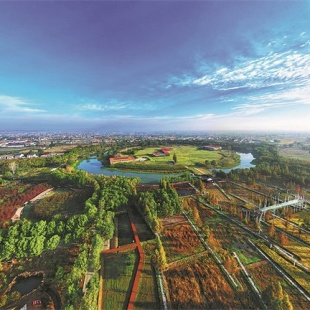
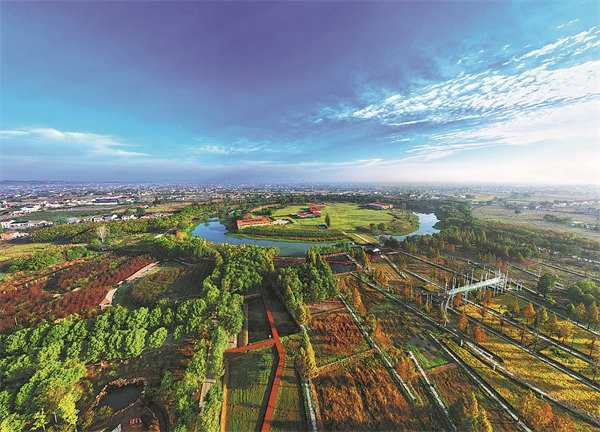
Now, the site has been built into a park, with most of its area backfilled with rice being planted by local farmers, continuing its role as farmland from thousands of years ago.
"Such plantings do not harm the site since the crops don't take deep roots. Therefore, we can see people have planted crops on this land for such a long time without destroying it. With limited funds, this is the best way we can balance protection and local people's life," says Zhou, who adds that many other sites of a similar scale on the plain are protected in this way.
According to Cao Yi, deputy director of Lixian's culture, tourism, radio, television and sports bureau, they have taken measures that can benefit local people as well. For example, they built roads and bridges in the site to facilitate the transportation, so that the site area has a better environment and farmers can farm more conveniently.
The major threats to the site are the building of homes and tombs and industrial production, which have all been banned. The site is monitored. To keep an eye on the site, they have turned a local residence in the scope into a keeper's office which serves as a rural library as well.
"We invited 68-year-old Zhong Jimu, a retired Party secretary of nearby Wufu village to work as keeper for the site. He manages the site and reports to the cultural heritage authorities if any things happen that shouldn't," says Cao.
"Moreover, we set up a small exhibition about Bashidang's history and significance in the rural library, and bought some children's books and books about farming techniques so that students in a nearby primary school can read and do their homework here after school. Farmers can also find useful books there as well," he adds.