


Porcelain base Shanglin Lake turns new corner









Shanglin Lake area was once a production hub for fine mise porcelain. Now it's an archaeological park firmly on the tourist trail. Wang Kaihao reports in Cixi, Zhejiang province.
It is cloudy, drizzling and slightly chilly. The weather here in early winter echoes with the simple but elegant celadon, a symbol of Shanglin Lake in Cixi city, East China's Zhejiang province.
Taking a boat across the water, visitors stepping onto an island there will probably be astonished to find a landscape littered with layers upon layers of broken porcelain.
This is the location of the Housi'ao kiln in Cixi, part of the Shanglin Lake relic site. Unearthed in 2016, Housi'ao was included in the annual list of "China's top 10 new archaeological discoveries" that year.
As a key component of the porcelain production sites in Cixi and nearby regions, collectively known as the Yue Kiln, Shanglin Lake was a celadon production hub that was in operation for a millennium, according to Zheng Jianming, a researcher at Zhejiang Provincial Research Institute for Cultural Relics and Archaeology.
More than 180 kiln spots have been unearthed so far around the lakeside.
"Many breakthroughs in early-stage porcelain making, which dates back 2,000 years, took place in Zhejiang," Zheng says. "There was a huge amount of production and the skills used were cutting edge at that time."
Earlier this month, Shanglin Lake Yue Kiln Site became one of the 12 new entries to China's national archaeological park list, released by the State Administration of Cultural Heritage.
A replica kiln has now been set up by the lake to portray how celadon was produced during ancient times, and a new museum, designed in the shape of a dragon, is also due to open to the public soon to give a panoramic introduction on the development of Yue Kiln. The dragon shape was a typical style used in kilns of the area.
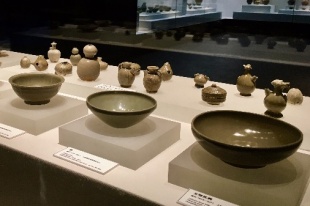
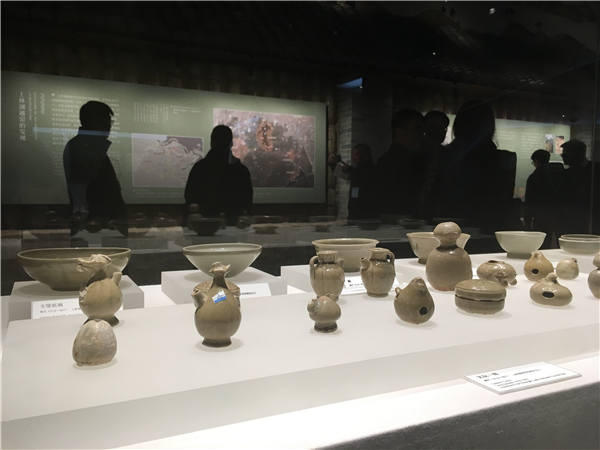
Zheng explains that mise (literally, "mystical-colored") porcelain, created using a closely guarded formula and was exclusively provided to emperors from the late Tang (618-907) to early Northern Song (960-1127) dynasties, represented the finest of Yue Kiln products.
People rarely understood what mise porcelain meant, although the term frequently appeared in ancient documents, until 13 such porcelain articles were unearthed in 1987 from an underground altar at the Famen Buddhist Temple in Baoji, Northwest China's Shaanxi province. The word "mise" was carved on the inventory of the altar items.
The archaeological discovery of the Housi'ao site in 2016 showed that this was the home of mise porcelain production.
He explains that after the Anshi Rebellion, an eight-year-long nationwide war ensued that sparked a period of social upheaval in the mid-8th century, China's land trade routes linking it with West and Central Asia were blockaded.
"Consequently, the flamboyant artistic styles coming from the West were replaced with the plain but exquisite styles from southern China," Zheng says. "People were in search of inner peace, and such aesthetics pushed the subtle work of the Yue Kiln to its peak."
For instance, lotus flower petals are commonly seen in the shapes of Yue Kiln products of the time that were inspired by scenes in the river towns of southern China.