The Jiaolong, China's manned submersible, dived in the Mariana Trench on Tuesday, making the first of a series dives for the third stage of the country's 38th oceanic expedition.
The craft reached a depth of 4.8 kilometers at 9:49 am and remained submerged for about nine hours in all, said Tang Jialing, the pilot of the Jiaolong.
The Mariana Trench - in the western Pacific Ocean about 200 km southwest of Guam - is the site of Challenger Deep, the deepest valley in the ocean. Tuesday's dive was made along the northern slope of the 11-km-deep valley.
In the next few days, the Jiaolong will make another dive to 6.3 kilometers and three more to 6.7 kilometers in the Marina Trench.
During these dives, it will collect samples of seawater, sediment, rocks and deep sea creatures to study the trench's geochemical and biological activity, Tang said. In later missions, the Jiaolong will retrieve a deep-sea sampler planted there at a depth of 6 km last year.
Next, the expedition will sail to the Yap Trench, on the southern tip of the Marina Trench, and make five more dives.
The 38th oceanic expedition, which began on Feb 6, is the longest and includes the most missions yet for the Jiaolong. The first of its three stages took place in the Indian Ocean for 59 days, and the second in the South China Sea for 34 days, according to China's National Deep Sea Center.
The third stage began on May 16, when the scientific expedition ship Xiangyanghong 09 set sail for the Mariana and Yap trenches carrying the submersible and 96 scientists. The entire expedition is planned to end on June 9, when the Xiangyanghong 09 returns to port.
The deep sea is often regarded as Earth's last frontier. Its exploration can yield better understanding of how organisms adapt and live in the world's most extreme environment, said Wu Changbin, commander of the expedition's third stage.
The ocean's floor in the Mariana Trench is dark place with water temperatures from 1 to 4 C and atmospheric pressure 1,000 times greater than at the sea's surface.
Yet life blossoms, due to hot water vents that emit chemicals such as hydrogen sulfide, which bacteria and other microbes can feed on and in turn support a variety of exotic creatures ranging from giant amoebas to bioluminescent fish.
Chinese scientists discovered 27 such vents in the Indian Ocean during the first stage of the expedition. In the South China Sea, they found rare bio examples such as sea lily and a branch of red coral attached to polymetallic nodules - clusters of minerals containing more than 10 elements, ranging from cobalt to manganese.
The Jiaolong, named after a mythical dragon, reached its maximum depth yet of 7,062 meters in the Mariana Trench in June 2012. China is building a new mother ship to operate and support the Jiaolong, and it is expected to enter service in 2019.
Xinhua contributed to this story.
zhangzhihao@chinadaily.com.cn
Thrill of the chase enlivens day's dive
Tuesday was a fruitful day in the Jiaolong's first dive into the Mariana Trench.
In the morning, China's manned submersible descended 4.8 kilometers along the northern slope of Challenger Deep, the deepest spot of the trench measuring at 11 kilometers.
Staying underwater for nine hours, the vessel collected 26.3 kilograms of basalt samples, 16 liters of seawater, extensive survey data and high-definition video and photos, according to the State Oceanic Administration.
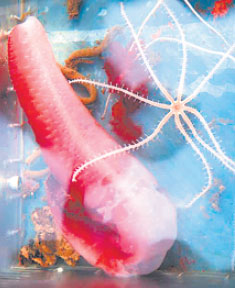
But the most intriguing rewards were the deep-sea creatures, including a sea sponge, a brittle star, two starfish and, as catch of the day, a 35-centimeter red sea cucumber.
Scientist first saw the giant sea cucumber as Jiaolong was descending to 4.8 kilometers, said Tang Jialing, the pilot of the submersible. But the visitor startled the creature and it fled "wiggling its body in an S shape, almost like dancing," he said.
Half an hour later, Tang saw a similar sea cucumber, possibly the same one. "You're not getting away this time," he said, and he caught it with the Jiaolong's mechanical claw. But the claw was too big, and the creature struggled to break free.
It eventually did escape, but swam in the wrong direction and into the sample container. "This is a very lucky day," Tang said.
Chen Xinhua, chief scientist for this third stage of China's oceanic expedition, said studying the basalt samples can help us understand the formation of the trench. The bio samples also have great research value in fields such as deep-sea biodiversity, ecosystem and biogeography.
The dive also allowed comprehensive testing of Jiaolong's systems that showed the submersible was operating smoothly, said Wu Changbin, chief commander of Tuesday's operation.
By Zhang Zhihao
|
The giant red sea cucumber that was collected on Tuesday. Provided To China Daily |




Copyright 1995 - . All rights reserved. The content (including but not limited to text, photo, multimedia information, etc) published in this site belongs to China Daily Information Co (CDIC). Without written authorization from CDIC, such content shall not be republished or used in any form. Note: Browsers with 1024*768 or higher resolution are suggested for this site.
License for publishing multimedia online 0108263 Registration Number: 130349