|
A good start to tackle city's traffic woes
By Gu Wen (China Daily)
Updated: 2006-11-17 10:34
As a Beijing motorist who owns a car, I responded to the call of the local "drive one day less" campaign in early November when African leaders were in town for a summit.
Actually, I didn't drive for six days in a row, like hundreds of thousands of other motorists in the city who either volunteered to switch to public transport or simply weren't allowed to drive their cars. Official figures show that a total of 490,000 government cars were banned from the streets during the summit to reduce traffic congestion and exhaust fumes.
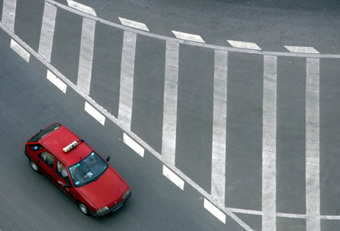
A taxi travels on a road in Beijing June 14, 2006. China needs to improve public transport to help curb choking traffic jams instead of building more and more highways to make room for private cars.[Reuters/File Photo]
 |
If the combined efforts of the government and the general public worked this time, it's thought similar measures could be adopted next year during test-runs and certainly during the Beijing 2008 Olympic Games.
So I decided to get an early taste of Olympic-style transport in Beijing. To my relief, my days as a commuter turned out better than I had expected.
To get to my office, I needed to use both subway and bus. The bus ride could easily turn into a nightmarish experience because the route cuts across one of the officially designated 59 busiest locations that are routinely plagued by traffic jams. But during the six-day period there were no such clogged arteries in the downtown area and nobody complained about getting stuck in traffic for half an hour or more.
It seemed that overnight the city found the cure to its chronic transport congestion problem fewer cars on better roads.
Interestingly, although nearly half a million government cars were kept garaged during the Sino-African meeting, officials said the ban had hardly interrupted their work. This captured some pundits' imagination: If this is true, does it mean the capital just has too many government cars?
And although this time Beijing did not adopt any compulsory policies on privately owned vehicles, can the city also reduce the number of private cars?
I believe there will be more private cars on the road in the next couple of years, despite environmental efforts such as the "drive one day less" campaign.
Time is my top concern when I choose driving as my mode of transport. Despite occasional traffic jams on the ring roads at peak hours, I still drive to work, which takes about half an hour per trip on a normal day. In comparison, it would take me 15 minutes to walk from home to the subway station and get on the train. Then I'll need another 15 minutes to leave the train and catch a bus. That's what urban economists describe as the "connection phase" for commuters to get to the train or bus. The time spent on the train and bus can be longer.
Besides, a car is a source of status in an increasingly affluent society. Around us we see more and more colleagues owning their first or second cars. And once people own a car, its expenses could reach tens of thousands of yuan a year. The owners might find it too expensive to leave the car at home.
However, it may still be possible to reduce the use of private cars by encouraging more people to drive less through government intervention and voluntarily. For example, electronic toll gates on busy expressways and in business districts may effectively regulate traffic flow and force car users to travel at off-peak hours.
The new traffic control mechanism is a good beginning to the city's long battle against traffic problems.
|