When the Chinese synchronized swimming team celebrated winning its first-ever Olympic medal, the first person they thanked was their Japanese coach Masayo Imura.
Serving as the team's head coach since the beginning of last year, the legendary Japanese coach's wisdom lifted the team onto the Olympic podium.
"After Imura took the helm, she brought a lot of changes to our team with extended and new training methods," said team captain Zhang Xiaohuan, who finished seventh in the duet event at the 2004 Athens Games with her partner Gu Beibei. "She is very hardworking and very strict. She brought new techniques to us and corrected our improper skills."
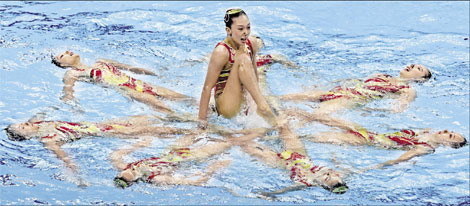
China's synchronized swimming team performs in the final of the team free routine August 23 2008. China won the bronze medal. [Agencies] |
Imura, 58, is the first Japanese coach of a Chinese national team. Known as the "godmother" of Japanese synchronized swimming, she coached Japan's synchronized swimmers for 30 years and helped them win three gold, one silver and four bronze medals at the Asian and Olympic Games.
Imura signed a contract with the Chinese team after the 2006 Doha Asian Games, where China dethroned Asia's long-time leader Japan both in the team and duet events. She continued to work her miracles in Beijing.
The team edged archrival Japan to win bronze in the synchronized swimming team event Saturday. The Japanese team shared fifth place with the US.
It was also the first medal for China's synchronized swimming team at any major world competition.
"We achieved a podium finish through 25 years of effort and we are extremely happy about it," said Zhang. "Generations of Chinese synchronized swimmers gave us great support and it is an achievement for all of them."

In the duet event finals on Wednesday, the Chinese twin duo Jiang Tingting and Jiang Wenwen finished fourth, which was also the best result for a Chinese team in the duet event.
"I'm very happy that I could help the Chinese team make this great breakthrough, since China has put its trust in me," Imura said. "It's not a surprise; it was our goal."
The Chinese synchronized swimming team took part in the Olympics for the first time at the 1988 Seoul Olympic Games, where it finished ninth in the duet event and 11th in the individual (there was no team event back then).
At the 2000 Sydney Olympics, Chinese swimmers finished seventh in the team event; they were sixth at Athens 2004.
Under Imura's guidance, the team kept moving up, notching fourth place at the 2007 World Championships, behind powerhouses Russia, Spain and Japan.
Imura said power and solid techniques are what she brought to the Chinese team, which has always impressed the world with its graceful moves but has been faulted for its poor technique.
Her Chinese colleagues expressed their gratitude as well.
"The biggest improvement that Imura brought to us is in our techniques," said Zheng Jia, one of the team's Chinese coaches. "The Japanese swimmers are good for their fine techniques, but the Chinese have lacked those advanced skills in the past."
But the techniques are not the only reason behind China's breakthrough. The host team also stunned the world with their routines, which featured elements of classic Chinese culture.
To the music of "Soul of Sword" the eight swimmers depicted the traditional Chinese martial art in their technical routine.
With a combination of powerful music from "Yellow River" and lyrics from "Jasmine", the team swam under the theme of "dragon", a traditional Chinese totem, in their free routine. It earned them the bronze.
Although Imura didn't disclose whether she would to stay on with the team after the Olympics, the Chinese team has already set its sights on further success.
