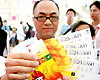
During the closing ceremony in Kuala Lumpur, the local host had his mind elsewhere for a second when he told the cheering crowds as the community cauldron was about to be lit: "Now, please welcome the flight attendants on stage."
As local spectators laughed it off, I thought to myself, had a slip of the tongue like this taken place in China, the audience would have treated it quite differently.
Many in the West would not mistake these men for flight attendants. Some have accused them of being too tight and concerned-looking, and a few have even called them "thugs".
That couldn't be further away from the truth. These are the people who have moved me most since our journey began. They each see this mission as the noblest in their career and treat the Olympic flame, torch and security lantern as holy.
They've protected the flame with nothing more than their flesh. And yet they have become victims of misunderstanding.

Why this misunderstanding? Two factors come to mind: different cultural preferences and language barriers.
It is a well-documented fact that Chinese favor uniform performances in ceremonial contexts, which we see with a much more serious attitude than most Westerners.
Chinese are obsessed with perfection. We love having things in good order. That should clarify why the flame attendants underwent strict training before our global trip. Yes, this is the Olympics. That's exactly why we do it so.
And that's also exactly why in the West, where individualism and displays of personality are stressed and endorsed, people may see it under dramatically different lenses.
The Greek side was upset at the rehearsal for the handover when four attendants holding the Chinese national flag walked especially straight and held the flag especially high.
No guys, please, be more relaxed and hold your flag lower, they were told.
The attendants did just that at the ceremony, and the Greeks were very pleased.
It is difficult to send the same message in different contexts. Aesthetic values are different across cultures.
For one, our attendants were very nervous at the lighting ceremony when the first Greek torchbearer stood for a while waiting to run. Our torch, built with energy saving in mind has only a small gas tank that burns for little more than 10 minutes. Everyone had the same question in mind: What if the flame goes out? The Chinese people who are watching this live on TV won't accept it!
It was a miracle that it didn't that day. But this incident alone explains the cultural divide. Sometimes we Chinese take things too seriously. We saw it as a big problem, whereas people in the West held a much more tolerant view of the situation: If the Olympic torch goes out, just light it again!
In any event, what in the West may be treated as a casual sports gala is seen very differently in China, where people always expect nothing less than perfect.
The result: Stiff faces on our boys when they couldn't transfer the flame from the cauldron to the safety lantern in the wind at the end of the relay in Bangkok.
Add this to the language barrier. Language has a bridging effect. When that bridge doesn't exist, communication between people takes place first through facial expressions.
But Chinese people think it is inappropriate to smile on solemn occasions, so the attendants showed no emotion. And because they cannot not communicate in English or any local language, what are they to do when, say, a torchbearer holds their torch too low?
Helping them lift it seems obvious, but that leads to a new series of misunderstandings.
The Olympics is a place where people come in peace to bridge differences; the 1.3 billion Chinese, too, see it this way, albeit with much deeper emotions than words can say.
The huge pressure on the Olympic convoy must be understood in this context. And finger-pointing doesn't help.
Qu Yingpu, deputy editor-in-chief of China Daily, is spokesman for the Beijing Olympic Torch Relay
(China Daily 04/23/2008 page4)