OPINION> Commentary

|
OPINION> Commentary
|
|
Museum can show how to use and save Nature
By Qin Xiaoying (China Daily)
Updated: 2008-06-13 07:41 Calls for building a Wenchuan earthquake museum started appearing in newspapers soon after the natural calamity had struck. I believe a large natural disaster museum, featuring a rich content and functioning as a lasting reminder and an educational facility, should be built in a well-coordinated manner. It should be carefully designed to house all kinds of visual and audio materials as well as artifacts and literature about significant natural catastrophes. My reasons for suggesting the establishment of a national museum of natural disasters are as follows.
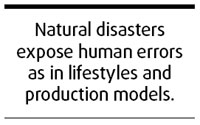
First, it can show the public the reality that China is a country where natural disasters happen frequently. The nation has never known a year without floods, drought, earthquakes, typhoons and many other primary and/or secondary disasters. According to written records, China has experienced at lest 3,200 destructive earthquakes since BC 1931. The occurrence of natural disasters appeared to have gained in both frequency and intensity during the Qing Dynasty (1644-1911), when the Yellow River burst its banks 364 times in the first 200 years of the country's last feudal era and 107 times in the 38-year history of the Republic of China (1911-1949). On December 16, 1920, an 8.2-magnitude earthquake in Haiyuan, Gansu province, took an estimated 200,000 to 300,000 lives. Since the founding of the People's Republic of China in October 1949, the number and severity of various natural disasters have been somewhat reduced thanks to organized human efforts against the destructive power of Mother Nature. Some epidemics, such schistosomiasis, were basically wiped out for some years. Generally speaking, however, natural calamities have been a constant threat to people's lives and property while causing tremendous losses to the national economy. These records have to be kept fresh for generations to learn by heart so that they know they must be well- prepared mentally as well as materially to fight for their own preservation. Second, the museum can systematically explain to the society the causes of various natural calamities and help enhance people's awareness of environmental protection, science, harmonious development and disaster prevention and reduction. It will also greatly help improve the effectiveness and accuracy of emergency management mechanism and system, while contributing to the advancement of related scientific research and applicable technology. Such a museum should also go a long way in exerting a potent and lasting influence on efforts to turn disaster reduction and relief from a charity-oriented temporary job into an industry in its own right. Literally, natural disasters are works of Mother Nature, but they always manage to expose human errors as in lifestyles and production models that help trigger or intensify their destructive force. Such errors include inefficient production, population explosion and ecological damage. The Chinese population remained below 100 million before the Qing Dynasty came into being. It topped 100 million for the first time in 1741 (the sixth year of Emperor Qianlong's reign) and soared to 410 million a century later in 1840. In that century the per-capita area of arable land shrank while the population literally exploded, which inevitably led to blind development, characterized by deforestation and wanton farming, much to the mad destruction of local eco-systems. Dr Sun Yat-Sen, our nation's pioneer in democratic revolution, once said while analyzing the country's flood problem, "Why are there more floods every year? It's because of excessive lumbering and no tree-planting afterwards, which leads to deforestation. Many mountains have turned barren with no forest on them to absorb and hold back rainwater, which becomes a flood when it pours. The best way to prevent floods is to plant forests." Today, there is probably no better way to collect such highly intelligent observations for posterity to learn by heart than a museum. Third, such a museum can broaden the Chinese people's vision and let them learn other countries' experience in disaster prevention and reduction as well as emergency management and civic quality education. Some of the countries rendered quake-prone by tectonic movements underneath them, such as Japan and New Zealand, have gained a lot of experience in minimizing the damage caused by earthquakes. New Zealand's low-rise, light-weight building designs and movable facilities on rail tracks in national key projects and the emergency survival kits Japan provides for its people all reflect the people-first doctrine and protection-oriented philosophy. China can most certainly learn from them and apply the knowledge to our own benefit. Fourth, such a museum can give people a better understanding of the relationship between "natural calamities" and "human disasters", or the relationship between natural phenomena and human society. A thorough understanding of the relationship between "natural calamities" and "human disasters" can inspire the general public as well as the policymakers and consequently advance social reform toward a more enlightened civic society. The author is a researcher with China Foundation For International and Strategic Studies (China Daily 06/13/2008 page8) |