Op-Ed Contributors
Ill wind may blow some good for schools
By Grayson Clarke (China Daily)
Updated: 2010-01-08 07:57
 |
Large Medium Small |

A couple of months ago, I was intrigued to read a report in China Daily about the growth of home schooling among Beijing's expatriate community.
As parents of two young sons, one in grade 2 and the other nearing kindergarten age, my wife and I gave home schooling some considerable thought last year because we were rather dissatisfied with his grade 1 school.
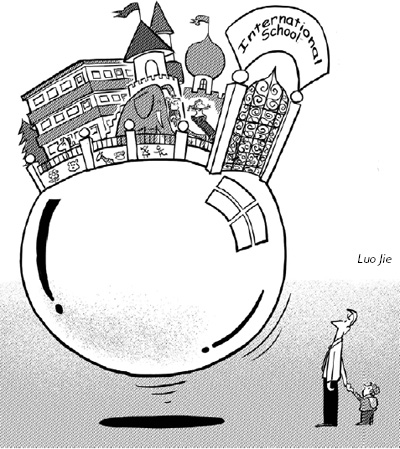
In the end, we decided against it. But it comes as no surprise to see an increasing number of parents inclined toward it because of the astronomical cost of international schools and the absence of any local option.
| ||||


English language international schools are extremely expensive. The tuition fees they charge for primary level is at least half as much as a top quality private school in my home country, the UK, and a comparable amount to a world-class university such as Oxford or Harvard.
Of course, there are good reasons for this. They have no endowments, have high start-up costs in terms of capital infrastructure and do need a core of international teachers.
Still their fee structures are so similar that in other circumstances you would think a price fixing cartel was in operation, calling for a competition investigation.
It's not just the tuition fees. There are transport costs, lunch allowances, capital levies, registration fees and refundable deposits - most of which have to be paid in advance.
There has been some relaxation in payment terms in response to the global economic crisis and the drop in demand - but still international schools are very expensive, especially if you have more than one child to educate.
Then there's the question of quality. I don't want to generalize from anecdotes or personal experience (my son's time in an international kindergarten was very good). Of course many, but not all, of the schools have good facilities - playgrounds, computer centers and even theatres. But what matters at the end of the day are not the facilities but what a child is taught.
English language schools in China face some special difficulties compared to other schools. To be financially more viable they need to appoint non-native speakers as teachers. This makes integration difficult for native-speaking pupils. Besides, the requirement to build knowledge of English language in the early years overshadows the need to build other skills such as handwriting and mathematics.
Another problem that all international schools face is the transitory nature of their pupils. Many of the pupils attend a school for a couple of years before moving to another city or country or back home because their parent/s are transferred or shift base.
So international schools are not accountable in the same way that schools back home are for the eventual outcome of pupils through all the grade levels.
I know a case in which a nine-year-old boy came out of an international school barely able to read or write. That made several psychologists to diagnose him with having learning difficulties until one realized that he had just been taught badly. Nevertheless, he had to spend his teenage years back in his country playing catch-up.
This lack of accountability means that some-times schools focus too much on providing pupils a good time (that is, not too much work and definitely not too much criticism) and not enough on imparting the skills they need.
The ill wind created by the global economic crisis may prove to be a blessing for international schools in China if it makes them focus more on their quality of education and less on treating pupils' parents and their sponsors as "cash cows".
If international schools want to reduce their costs and still have a committed and effective group of teachers, they should spend more time and resources on developing local teachers and building a career path that supports their recruitment, retention and develop-ment.
International schools have to be clear about the curriculum they teach and what they expect a pupil to be able to do at the end of each semester, and capture it in a report that may serve as a kind of passport to the next school where the pupil goes. This will make it much easier for parents to track their wards' progress, schools to monitor the results and receiving schools to know incoming pupils' strengths and weaknesses.
And they should pay more attention to costs and flexible fee structures for parents who can't pay full fees. The recent changes forced on some schools - abolition of the capital levy and monthly payment terms are things that should be extended to other schools. So should the choice of half-day schooling - at least up to primary 4. It's amazing what you can teach in four hours if you are well organized.
I should know. My son is lucky enough to attend one of the best, if not the best, primary schools in Beijing that teaches for four hours at a fraction of the cost of most other international schools. I think he has learned more in one month than in the whole of last year. Like many things in Beijing, price definitely does not (yet) equal quality.
The author is an international consultant based in Beijing.
(China Daily 01/08/2010 page9)