Op-Ed Contributors
Road traffic: Jams today, jams tomorrow ...
By John Scales and Paul Amos (China Daily)
Updated: 2010-09-15 07:55
 |
Large Medium Small |
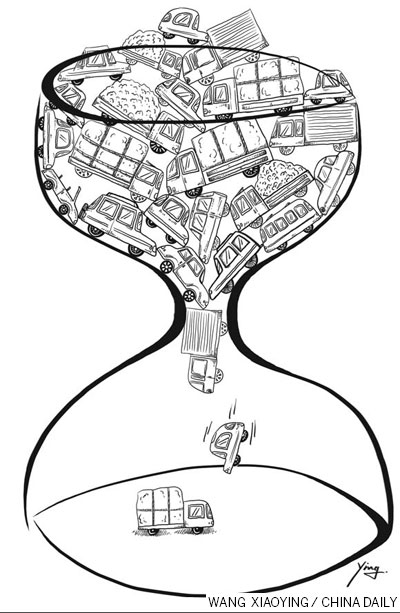
The recent 100-km long traffic jam on the Beijing-Tibet Expressway, which extended till Beijing's outer suburbs caught the world's attention because of the sheer scale of the block and the length of time that people were caught up in it. But media coverage in many of the world's most affluent countries was generally received by audiences with a wry smile that said: "China, welcome to the motor age."
While the recent traffic jam in China has been blamed on the large number of trucks transporting coal along the highway, many are concerned that such jams will become widespread in the country as auto ownership continues to increase.
In Los Angeles, for example, which is famous for its high-capacity regional freeway network, the long-suffering residents of Los Angeles experience traffic crawl on their drive to work nearly every day. Germany is equally well known for its extensive network of intercity autobahns - but Germans setting off on a drive to Berlin or Munich in summer do so amid a flurry of radio warnings of traffic jams along the way that often bring their eager and powerful BMW and Mercedes cars to a standstill.
So why do traffic jams occur? And can anything be done about them?
Road congestion occurs when the demand for use of road space exceeds the available capacity. Road traffic engineers can broadly predict the point at which a free flow of traffic starts to break down on a particular road type, using what is known as the speed-flow curve. After that point, increasing traffic flow leads to rapidly falling average speed and, ultimately, to a stationary and increasing traffic queue as new vehicles join it at a faster rate than those leaving it.
It is sometimes easy to see what starts this process. A traffic accident or road construction works or (as we understand to have been the case on the Beijing-Tibet Expressway) a combination of these can create a short-term loss of capacity or supply, so that the remaining capacity is quickly overwhelmed by demand. Conversely, major public events or breakdowns in the rail system can temporarily boost road transport demand relative to supply of capacity, with the same result.
But the fact is that many, if not most, traffic jams are not because of temporary phenomena. Instead, they are recurrent features of roads that are regularly saturated relative to their capacity. During peak demand, heavy but still moving flows of traffic can quickly deteriorate into a jam through very minor incidents, such as one driver trying to change lanes or another suddenly braking, which causes ripple effect that can bring the flow to a halt many kilometers down from the point of the incident.
The important question then is what China can do about managing the use of road space better: The answer will be central to the country's transport strategy over the next decades. China's rate of car ownership per head of population is still only about one-twentieth that of the US and Germany. Rising incomes in China will be accompanied by increasing demand for personal mobility - for car ownership, for more goods that need transporting, and for an even higher rise in road use. That traffic snarls will increase is inevitable. But it is possible to adopt policies that may ameliorate the prevalence and severity of such congestions.
China's trunk road density is only a fraction of developed countries' and the need to continue construction of new high-capacity roads on inter-city routes cannot be doubted. But that alone will not prevent traffic congestion during peak hours. There are many other measures that we see as essential.
The first is to ensure that the rail transport system is equipped to play an optimal role in freight and passenger transport in China. The sight of long rows of coal trucks in the recent jam is particularly ironic as it costs China substantially more to carry coal on trucks than on trains. With one-sixth of the verified coal reserves of China in the Inner Mongolia autonomous region, it is small wonder that transport facilities are currently overloaded. Fortunately, much extra rail capacity is already being built in this corridor both for coal and passenger services.
In cities, there is no hope at all of avoiding road congestion by building more roads: there is simply not enough land to try to do so without unacceptable deterioration in city amenities. Much greater emphasis needs to be given to investment in and management of all forms of public transport, including (perhaps especially) road-based modes such as bus rapid transit and light rail systems. Also, the logic for pricing such a scarce and valuable resource as urban road capacity has always been strong. The practical need to do so in many Chinese cities is increasing and the technology for implementing urban road pricing is improving all the time.
In short China needs to continue to pursue a combination of policies for trying to manage road use and traffic congestion, and such policies will undoubtedly help. But with China's rapid growth in private road transport demands, we will all need patience as well.
John Scales is China Transport Coordinator at the World Bank Office in Beijing, and Paul Amos is a consultant to the World Bank .