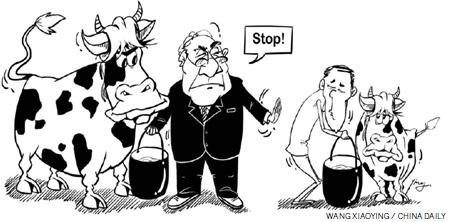
The World Trade Organization's (WTO) trade talks, known as the Doha Development Round, are in crisis. The differences among key countries are so wide that they appear to be "unbridgeable". This became evident from the WTO's latest 600-plus-page report, which was issued last month.
At a meeting on April 29, WTO member states agreed to try again in May to find a political solution, so that a deal could be struck by the end of this year.
The deep impasse has not been caused by technical issues alone. There is a clash of paradigms, too.
But rich countries have given the developmental aspects a not so silent burial. Instead, they have made opening up developing countries' markets the main aim of the talks, while using the many loopholes to escape serious obligations of their own. Needless to say, they have mainly succeeded in this, as can be seen from the WTO report issued in April.
According to the report, developed countries would be allowed to continue granting high subsidies to their agriculture sectors. The only change would be in name and type. They'd be allowed to shelter their "sensitive products" from steep tariff cuts, too.
In contrast, developing countries would have to cut their farm tariffs more steeply (by up to 36 percent on average) than they did during the Uruguay Round (24 percent on average). While they'd be allowed to have a new special safeguard mechanism aimed at avoiding rapid increase in imports that could damage local farm productions, the proposed mechanism would be difficult to use and of very limited benefit.
Worse is the proposed text on industrial tariff cuts. Under a specific formula, developing countries would have to cut their bound tariffs on industrial products very steeply. The developing countries hurt by the formula would end up with average applied tariffs of 11-12 percent and thus risk cheap imports damaging their domestic industries.
 New type of urbanization is in the details

Copyright 1995 - . All rights reserved. The content (including but not limited to text, photo, multimedia information, etc) published in this site belongs to China Daily Information Co (CDIC). Without written authorization from CDIC, such content shall not be republished or used in any form. Note: Browsers with 1024*768 or higher resolution are suggested for this site.
License for publishing multimedia online 0108263 Registration Number: 130349