Three years ago, I sat in Beijing National Stadium (Bird's Nest) and witnessed one of the most spectacular staged events in recent history. The seamless perfection of the 2008 Olympic Games Opening Ceremony heralded China's arrival as a cultural, political and economic power. Impressed and delighted by the pageantry as I was, I wanted more from that moment.
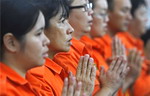
I wanted China to use that golden moment when it captivated the world to share its vision for the future. I wanted to know the meaning behind the slogans and catchphrases. Whose "dream"? Whose definition of "harmony?" Even though the official programs offered a few answers, I found genuine utopian moments in the Games. As an avid sports watcher, I was inspired by the superb sportsmanship of the athletes and fans when I watched the Olympic events over the following weeks. And lest we forget, the thousands of volunteers who lent their services deserve praise again.
Three years later, I trust that many of those involved with the Olympics have found ways to channel their experiences into their daily lives.
Anniversaries are arbitrary markers of time, but they offer us opportunities to draw connections on the broader horizon and reflect on them. Zooming out from the scale of individuals, the effect of the Olympics on China as a whole can be measured in several tangible ways.
We may remember that the infrastructure preparations for the Games were controversial for displacing many Beijing residents. Though the architectural loss still cannot be counted, we can see the benefits the Olympics infrastructure have had. The iconic Bird's Nest and Water Cube have become two of the most popular tourist attractions in Beijing. Positioned on the same north-south axis as the Palace Museum, these modern feats of design and engineering point to China's future while honoring its past.
Other physical legacies of the Olympics that continue to benefit China include the subway system, which has made moving around the sprawling city easier for residents and visitors alike.
The legacy of the Olympics should be measured as much by what did happen as by what didn't. Because the threat of international and domestic terrorism looms large over all large-scale events, security is an unfortunate but necessary priority. With the exception of isolated incidents, organizers of the Beijing Games have to be commended for securing the venues. Beijing offers hope to all future Olympics host cities, including London, for achieving success without kowtowing to fear.
The success of the Beijing Olympics shows that China has no longer to prove itself. During a recent visit to Shanghai, Jacques Rogge, president of the International Olympic Committee, said Shanghai, too, has the capacity to host the Games. Interestingly, Chinese people seem unmoved by the compliment. In fact, a majority of Chinese netizens have said the inconvenience associated with hosting such events outweighs the benefits. The increased confidence of the international community in China's ability and correspondingly Chinese citizens' skepticism over such events show how power and agency have shifted hands in merely three years.
In the run-up to the 2008 Games' anniversary, other seminal moments in Chinese sports history were created. Just two weeks ago, the flag-bearer of the 2008 Games Opening Ceremony, Yao Ming, retired from the NBA. Even though Yao is a veteran, he is only 30 years old, a shockingly young age for retirement for anyone outside of the sports world. In less than a decade, Yao's accomplishments have been nothing short of a miracle. His fame and popularity made him the most successful cultural ambassador for China.
At a time when Sino-Western relations remain complicated, Yao's modest affability challenged the West's long-held stereotype views about China. Yao's seemingly impossible burden fueled early doubts about his ability to adapt to the aggressive pace and egocentric culture of the NBA. The young star, however, quickly quelled doubters by handling himself gracefully on and off court.
The end of Yao's era reminds us that individuals cannot carry the burden of Chinese sports, not even other sports stars like Li Na, who seems poised to take over Yao's torch as the next Chinese sports icon. As reflected by the successes of Yao and Li, and China's record medal haul at the 2008 Olympics, the centralized Chinese sports training system produces brilliant talents in many other games as well, such as swimming, badminton and gymnastics, not to speak of table tennis.
But the lack of Chinese team's victories in games such as basketball and men's soccer indicates that different strategies have to be adopted for success in different events. Many Chinese and foreign commentators have said that China's rigid system of recruiting athletes from childhood is the source of problem. I have to agree.
In my commentary on the Football World Cup, I advocated the fostering of a Chinese sports culture that places the love of sports, not the love of winning, at the core. As I reflect on my memories of the 2008 Olympics and speculate on Yao's legacy, what emerges is not moments of victories but the human connections inspired by sports.
The author is a media consultant based in Paris, France.
(China Daily 08/09/2011 page9)
 New type of urbanization is in the details

Copyright 1995 - . All rights reserved. The content (including but not limited to text, photo, multimedia information, etc) published in this site belongs to China Daily Information Co (CDIC). Without written authorization from CDIC, such content shall not be republished or used in any form. Note: Browsers with 1024*768 or higher resolution are suggested for this site.
License for publishing multimedia online 0108263 Registration Number: 130349