Xi's visit to the United States lays the foundations for a more effective working relationship between the two countries
At the invitation of his US counterpart Joe Biden, Vice-President Xi Jinping began a five-day official visit to the United States that concluded on Feb 17. The visit was highly valued by both sides.
Coinciding with the 40th anniversary of former US president Richard Nixon's visit to China and the publication of the Shanghai Communiqu, Xi's visit has put into practice the important agreement reached by the leaders of the two countries to promote the establishment and development of a cooperative partnership on the basis of mutual respect and mutual benefit.
The visit was also an important opportunity for US policymakers and members of Congress, as well as the business community and the public, to learn more about China's future leader, which will help lay the foundations for a more effective working relationship between the two countries.
Both sides recognize that it is of prime importance to keep Sino-US relations on a healthy and stable track in order to promote domestic economic growth and respond to complicated global and regional challenges.
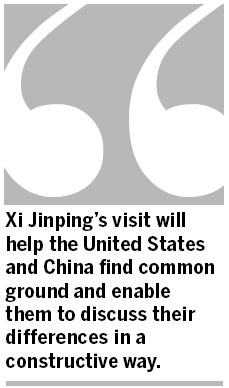
According to a report by the US Congressional Research Service, Xi's visit will have helped the two countries find common ground and enabled them to discuss their differences in a constructive way.
The extensive and significant common interests of China and the US are the foundation for a cooperative partnership. As long as the two sides focus on their common interests and avoid relations being dominated by contradictions and differences, they can pioneer harmonious coexistence, healthy competition and win-win cooperation among big powers.
But the building of a cooperative partnership can only be guaranteed if China and the US view each other's strategic intentions and development path correctly and objectively, and respect each other's core interests and major concerns.
"We are not always going to see eye-to-eye," Biden admitted, adding, "we have very important economic and political concerns that warrant that we work together."
In order to institutionalize the settlement of disputes, China and the US issued the Joint Fact Sheet on Strengthening China-US Economic Relations during Xi's visit, committing themselves to resolving their differences over the renminbi's exchange rate, market access, and trade frictions.
The exchange rate issue has long been a bone of contention between China and the US. But China has made it clear that it will act on its G20 commitment to move more rapidly toward more market-determined exchange rate systems. The US on its part has committed to achieving a more than $4 trillion deficit reduction over the next 10 years.
Honoring these commitments will help reduce economic and trade frictions between the two countries, and mitigate the strong criticism of China's exchange rate policies coming from the US government and Congress.
Both countries have said that the Sino-US relationship is one of the most important bilateral relationships in the world. Though experiencing a number of unhappy incidents at the second half of 2009 and through 2010, President Hu Jintao's successful visit to the US in January 2011 brought the Sino-US relationship back on track.
During his visit Xi reiterated China's unswerving commitment to its peaceful development path, and its sincerity in developing relations with the US. He expressed the hope that the US can understand China's intentions and make practical efforts together with China to enhance mutual trust.
For its part, the Obama administration reiterated that it has always been committed to strengthening relations with China and believes a prosperous and stable China is not only beneficial to the US, but also promotes peace, stability and prosperity in the Asia-Pacific region and the world at large.
However, US Secretary of State Hillary Clinton announced America's "back in Asia" strategy in February 2010 and in November 2011, President Obama stressed that the US would shift its military and security focus and resources away from the Middle East to Asia. During this period, the US also chose to actively get involved in the territorial disputes between China and its neighbors in the South China Sea, strengthened its security alliances with some of China's neighboring countries, and advocated the establishment of the Trans-Pacific Strategic Economic Partnership as a means of strengthening economic and trade relations with Asian countries, with the apparent intention of excluding China.
These actions mean China has reason to be suspicious about the intentions behind them.
In this context, Xi's visit has helped to show the desire and willingness of both sides to make efforts to build strategic mutual trust.
The author is a researcher in the Institute of American Studies under the Chinese Academy of Social Sciences.
(China Daily 02/27/2012 page8)
 New type of urbanization is in the details

Copyright 1995 - . All rights reserved. The content (including but not limited to text, photo, multimedia information, etc) published in this site belongs to China Daily Information Co (CDIC). Without written authorization from CDIC, such content shall not be republished or used in any form. Note: Browsers with 1024*768 or higher resolution are suggested for this site.
License for publishing multimedia online 0108263 Registration Number: 130349