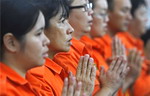
Nation yet to realize its Millennium Development Goal of letting women take 30 percent of seats in parliament
On International Women's Day, the UN System in China would like to note the significant gains achieved for women in China since 1949.
In 1950, Chinese women's average life expectancy was only 35 years. Now Chinese women can expect to live until the age of 75. In 1950, per every 100,000 live births, a shocking 1,500 Chinese women would die during childbirth. Presently, this figure is only 38 deaths per 100,000 live births.
In 1953, less than 50 percent of girls went to elementary school. By 1995, more than 90 percent of girls attended elementary school. In 1949, only 8 percent of women were part of the formal, paid work force in China. Currently, 63 percent of women have formal, paid employment. In 1954, women constituted only 12 percent of National People's Congress members. By 1975, they made up 23 percent of NPC deputies.
These are significant achievements that substantially raised the overall status of Chinese women since the founding of the People's Republic of China. These gains are primarily due to the government's active efforts to support gender equality. Campaigns for public health and literacy have benefited women immensely, as has the enactment of legislation to support women's rights, such as the Marriage Law, introduced in 1950 and amended in 1980, and the Law on the Protection of the Rights and Interests of Women, which was introduced in 1992 and amended in 2005.
Yet despite these very real gains for Chinese women, a closer look at the statistics tells another story. Women are not as equal in China as they are perceived to be.
The increase in women's political participation from the 1950s to the 1970s is impressive. Yet, since the 1970s, the percentage of women in the National People's Congress has remained static, hovering around 22 percent for more than 40 years. China is not on track to attain one of the targets of the third Millennium Development Goal, whereby 30 percent of parliament members should be women by 2015. In general, the higher the level of leadership the fewer women there are.
And worryingly, according to a 2011 survey conducted by the All-China Women's Federation roughly 25 percent of households in China experience domestic violence, and the victims are disproportionately women. Domestic violence occurs among families of all types and classes. Yet, due to a culture of silence around this problem, many people in China do not realize the extent of domestic violence in society, nor do many people know that it is a crime.
Another distressing statistic is the sex ratio at birth in China, which, due to the preference for sons in the rural labor force, is as high as 120.5 live male births for every 100 live female births. By the year 2020 there will be an estimated 30 million more men in China than women. The imbalance already has serious social repercussions.
Perhaps the most telling statistic of women's uncertain status in China, however, is women's income as a percentage of men's income between 1990 and 2010. According to surveys by the All-China Women's Federation, the percentage has been declining. In 1990, rural women's average income was 79 percent that of men's. By 2010, it had fallen to only 56 percent. Urban women's relative incomes have also fallen, but not as much. Clearly, women have not benefited from China's economic growth to the same extent as men, and rural women have benefited the least.
Increasing women's economic status is especially important as it has a positive multiplier effect on the education, healthcare, and nutrition of children and family members.
The UN System in China, in collaboration with the government and the All-China Women's Federation, has been working for many years to improve Chinese women's status through programs and initiatives, including an ongoing joint program to eliminate violence against women, which is still a serious problem. Yet, we frequently encounter the attitude among certain sections of public opinion that women already are equal to men or even enjoy a higher status than men. This belief simply is not true.
Women have a fundamental right to enjoy the same status as men in society, a right upheld by the Convention on the Elimination of All Forms of Discrimination Against Women, ratified by the Chinese government in 1981.
Abhimanyu Singh is chair of the UN Theme Group on Gender, and director and Representative UNESCO Beijing Office; Julia Broussard, with the Secretariat of the UN Theme Group on Gender, is Country Programme Manager for UN Women.
(China Daily 03/08/2012 page9)
 New type of urbanization is in the details

Copyright 1995 - . All rights reserved. The content (including but not limited to text, photo, multimedia information, etc) published in this site belongs to China Daily Information Co (CDIC). Without written authorization from CDIC, such content shall not be republished or used in any form. Note: Browsers with 1024*768 or higher resolution are suggested for this site.
License for publishing multimedia online 0108263 Registration Number: 130349