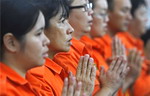
Gaokao: You can't live with it, you can't live without it. This is probably the best way I can describe how people feel about the all-important National College Entrance Examination that incarnates both a major education impasse and paradoxically, the pinnacle of Chinese social justice.
For evidence, I look to my recent column on whether a university should have trumpeted the number of top scorers in gaokao, which has triggered a torrent of responses from readers.
Some have echoed my opinion, like "Terrible System", saying the national examination produces one-sided students with no critical thinking and warning that "memorizing by heart everything is not education or learning, it's killing off something far more important to learn during your childhood: independence, leadership and critical thinking. Those are skills that once you lose, you almost cannot relearn."
But defending arguments were as, if not more, powerful. "Mencius", who posted thousands of words to make his point, believes "recognition of the gaokao champions for their diligence and talents will encourage other students to excel, and prevent mediocre students from taking the best positions, based not on ability, but on their connections".
I'm reluctant to judge who is right and who is wrong. The conundrum of gaokao even baffles the country's top education policymakers and educators, as I found days later at an international education seminar in Beijing.
There, Professor Tan Songhua, a member of the National Education Advisory Committee and one of the key architects of the gaokao system, conceded that holding the same tests for different universities has not been helpful in selecting students of diverse backgrounds and abilities, and admissions based mainly on gaokao scores have led to "a waste of precious time" for students who spend a year on raising just a few points to surge ahead.
In addition, the tests tend to emphasize "knowledge" rather than creativity of students, which limits the performance of examinees, he said.
However, even after decades of tinkering, the system has remained basically unchanged because in times when social trust is lacking, gaokao results are seen as the fairest criterion for admission to college, to the extent that they have become the "bottom line of social justice".
It would be unfair to expand the scope of gaokao, such as assessing musical talents, because of the vast gap between students from families in the more developed eastern cities and those in the poverty-stricken west, Tan said.
Still, education authorities have been pressured to overhaul the system, albeit in a slow and painful way. For example, in the coming years, gaokao scores could gradually be relegated to merely one of the criteria for admission, while the government exam departments could give way to "professional" test services, Tan told an enthralled audience, including American educators who are more familiar with standardized tests organized by nonprofit organizations.
But a holistic and coherent plan is yet to be worked out to make the changes, as decision-makers are weighing various options and will time their moves carefully to maintain social harmony.
The process could go faster than expected, with more students reneging on gaokao each year. At a panel discussion during the meeting, heads of several top high schools of the Chinese mainland that have thrived on excellent gaokao results enthused about their philosophy and achievements in nurturing all-rounded students, with cases including bird watchers, inventors, a filmmaker and a cyclist across the country.
Then where are the best and brightest minds headed after graduation?
"This would be the last question I want to think about, and even less to answer," lamented Liu Changming, principal of the popular Beijing No 4 High School. "Most of them have given up gaokao, because they consider it a waste of life. Except a few, all have chosen to apply to foreign universities."
The writer is editor-at-large of China Daily. E-mail: dr.baiping@gmail.com
(China Daily 08/04/2012 page5)
 New type of urbanization is in the details

Copyright 1995 - . All rights reserved. The content (including but not limited to text, photo, multimedia information, etc) published in this site belongs to China Daily Information Co (CDIC). Without written authorization from CDIC, such content shall not be republished or used in any form. Note: Browsers with 1024*768 or higher resolution are suggested for this site.
License for publishing multimedia online 0108263 Registration Number: 130349