Editor's note: The following is a speech delivered by Li Keqiang, premier of the State Council of the People's Republic of China, at the 16th National Congress of Chinese Trade Unions on Oct 21.

First of all, I wish to extend, on behalf of the Central Committee of the Communist Party of China (CPC) and the State Council, warm congratulations on the successful convening of the 16th National Congress of Chinese Trade Unions and the election of the new leadership of the All-China Federation of Trade Unions. I also wish to express sincere greetings to the hundreds of millions of Chinese employees and trade union officials and pay high respect to the Chinese working class. The working class plays an essential role in China's development. I know you follow with great interest the current state and growth trend of China's economy. Therefore, I have accepted invitation to talk to you today, and I will talk about three key issues.
First, the current state of the Chinese economy
The current state of the Chinese economy should be viewed against the background of the global economy. This government assumed office in an intricate domestic and international environment, particularly the weak recovery of the global economy. Major developed economies are all experiencing sluggish growth. Even those doing well are only growing by just over 1%, and others have registered negative growth. The larger economies among developing countries and emerging markets have grown at a rate of below 2%, and a few with better performance have only achieved no more than 5% growth. In 2010, China's economy registered double-digit growth, up by 10.4% year-on-year. However, in the fourth quarter of last year, due to the combined impact of complex domestic and international factors, China's growth rate dropped to 7.8%, and the trend of economic slowdown has continued into this year, with GDP growth being 7.7% for the first quarter and 7.5% for the second quarter respectively.
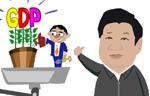
Why do I mention GDP at the very beginning of my address today? You may say we should not focus on GDP only. Of course, we shouldn't. But after all, China is still a developing country, and development remains the basic condition and key for solving all the problems we face in China. More importantly, GDP for us means employment. In the past, every one percentage increase in China's GDP created about one million jobs. Thanks to adjustment of economic structure carried out over these years, especially the accelerated development of the service sector, every percentage point of GDP growth now generates about 1.3 million or even 1.5 million jobs. I instructed the Ministry of Human Resources and Social Security and other relevant government departments to conduct an in-depth survey, and their conclusion is that in order to add 10 million new jobs each year, we need to maintain an annual GDP growth of 7.2%. In short, to ensure stable growth is to ensure employment.
What should we do in the face of downward pressure on the economy? To ensure stable growth and employment, we have two options. One is to increase deficit and money supply. In other words, to boost investment through deficit financing and printing money. While this could work within the year, space is needed for carrying out such fiscal and monetary policies. Moreover, it is hard to sustain such short-term stimulus. Currently, our deficit has reached 2.1% of GDP. What does this mean? The ceiling set by the EU is that a country's deficit should not exceed 3% of its GDP. Of course, many EU members broke the ceiling and we all know the result, which is the European debt crisis. It has lasted for several years now. In some countries, economic growth has stalled and even contracted, unemployment is high, and welfare benefits are no longer guaranteed. Talking about money supply, China's broad money supply (M2) exceeded 100 trillion yuan in late March, twice the size of its GDP. In other words, there is already a lot of money circulating, and more could lead to inflation. As you all know, when inflation goes out of control, it not only disrupts and damages the market, it can also cause a huge adverse impact and pressure on people's lives and even lead to panic.
 New type of urbanization is in the details

Copyright 1995 - . All rights reserved. The content (including but not limited to text, photo, multimedia information, etc) published in this site belongs to China Daily Information Co (CDIC). Without written authorization from CDIC, such content shall not be republished or used in any form. Note: Browsers with 1024*768 or higher resolution are suggested for this site.
License for publishing multimedia online 0108263 Registration Number: 130349