With the public consultation for political reform by the Hong Kong government in 2017 approaching, Western countries such as the United States and the United Kingdom are trying to meddle in Hong Kong's internal affairs, which could undermine the city's democratic progress.
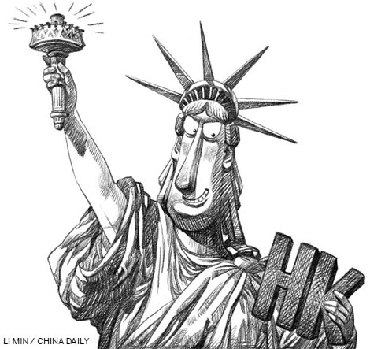
The public relations campaign of the US and the UK started in September, when British Foreign Office Minister Hugo Swire said the UK extends "support" to Hong Kong's political reform. Then waltzed in US Consul General Clifford Hart talking about universal suffrage. Recently, Chris Patten, the last British governor of Hong Kong, said he regretted not taking "action" on Hong Kong's elections during his governorship.
As the political reform enters the consultation stage in the coming months, more foreign officials are expected to make more provocative remarks. Such actions, amid the illegal Occupy Central (Hong Kong's business district) movement, are bound to backfire, but they could delay the implementation of universal suffrage in the Hong Kong Special Administrative Region.
Major powers such as the US and the UK should know best the importance of the bargaining process of politically different countries like China. The Western powers should realize that their aggressive remarks on political reform could easily be seen as a support for the opposition camp.
In fact, since the opposition camp started advocating the illegal Occupy Central (on the lines of Occupy Wall Street) campaign early this year, the atmosphere at the talks on political reform has hardly been optimistic. Attempts of the US and the UK to interfere in Hong Kong's affairs are making it even harder to reach an agreement on political reform.
The US and the UK are used to occupying a high moral ground and lecturing other countries on democracy and freedom. But a few months ago, Hong Kong residents got a real taste of US-style democracy when Washington tried to coerce the city's administration into extraditing Edward Snowden, the former National Security Agency operative who exposed the US' mass surveillance program. The US' surveillance is not limited to the Chinese mainland and Hong Kong, but also covers its allies such as Germany and Australia.
If Snowden hadn't blown the whistle, many Hong Kong residents would probably never have known that foreign intelligence agencies closely monitor their activities. For such infringement of privacy, the US owes Hong Kong and the rest of the world an unconditional apology.
While the veil of the US was lifted only after the Snowden episode, the UK's attempts to interfere in Hong Kong's affairs became known much earlier. The British colonial government improved its governance only after the riots in 1967. The UK was reluctant to give Hong Kong people the political reform they demanded until the post-handover negotiation period after 1990.
Recently, Pattern said he had "regrets" about the development of Hong Kong. This statement, like others of its kind, could undermine the trust between the opposition camp and Beijing. And lack of trust is one of the barriers in the path of political reform.
It appears that the US and the UK have made interfering in Hong Kong's affairs an integral part of their hidden political agenda on containing China's rise. We Hong Kong residents can do little to stop the two powers from behaving out of their self-interest, but we can certainly do our bit to facilitate the political reform process. This is especially true for some "pan-democrats". If they are sincere and serious about reforms, they should eschew radicalism and their foreign ties, and focus on proposals that are within the constitutional framework of "one country, two systems".
The central government will not concede even an inch when it comes to safeguarding the country's sovereignty. Hong Kong residents should understand that the Basic Law is basically a mixture of civil law and China's law. If we ignore the fact that "one country, two systems" was set up under the constitutional framework of China, and that the Basic Law is the national law passed by the National People's Congress to implement the basic policy of "one country, two systems", we will certainly go nowhere in terms of political reform.
To reach a consensus on political reform, stakeholders on both sides should try to see the issue from the other's perspective. But one thing is for certain, and that is that any proposal on how to seek universal suffrage for Hong Kong residents has to be based on the Basic Law and the constitutional framework of "one country, two systems" if one expects it to work.
The author is an associate professor at the School of Law, City University of Hong Kong, and an elected legislator in the Hong Kong Special Administrative Region.
(China Daily 11/27/2013 page9)
 New type of urbanization is in the details

Copyright 1995 - . All rights reserved. The content (including but not limited to text, photo, multimedia information, etc) published in this site belongs to China Daily Information Co (CDIC). Without written authorization from CDIC, such content shall not be republished or used in any form. Note: Browsers with 1024*768 or higher resolution are suggested for this site.
License for publishing multimedia online 0108263 Registration Number: 130349