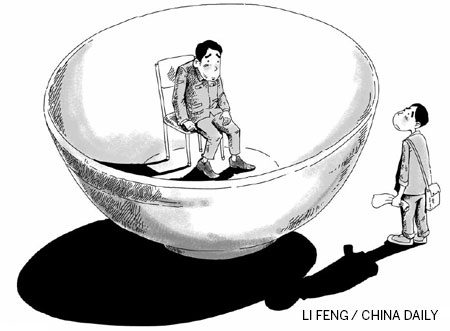
The Chinese media have been agog with reports on the possibility of some civil servants quitting their jobs and going into business. They will do so, the reports say, because the central government's eight-point code to reduce bureaucratism and maintain close ties with the people has, to some extent, truncated their welfare and perks.
Contrary to popular belief, most civil servants don't live a life of luxury and leisure, and some of them have to even work overtime and during the weekends. The average salary of junior local-level officials is about 2,000 yuan ($330) a month, a relatively low amount given the rising prices. The truth is, most public servants can barely manage to make both ends meet.
This has created a peculiar situation: Some young public servants regret channeling all their efforts into getting a government job, while quite a number of college graduates, encouraged by their parents, try their best to become civil servants. The situation resembles that of "a besieged city", with people outside desperate to get in and those inside dying to get out.
According to official data, 9,763 new civil service positions were available in 2011, 10,486 in 2012 and 12,927 in 2013. But the number of candidates who took the civil service examination for these vacancies was 900,000 in 2011, 960,000 in 2012 and a whopping 1.12 million in 2013. No wonder, the public refers to the civil service examination as the "national exam".
This awkward situation can be attributed to some social factors. People, in general, regard the civil service as an idle occupation. The common perception is that a government official's job is "just reading a newspaper with a cup of tea and cigarettes".
The wrong notion about the civil service is not restricted to just the nature of the work; it extends to the number of people working as civil servants. According to a widely circulated statement, "there is one civil servant for every 26 people" in China, a much higher ratio than in other countries. But the fact is that of the 30 million professionals working in public institutions, 15 million are teachers and administrative officials, and more than 8 million are employed in medical services, because most schools and hospitals in China are public institutions. These people are not truly civil servants.
The actual number of civil servants in China would, therefore, be between 7 and 8 million, with those staffing government-affiliated institutions being 4 to 5 million. That puts the total number of civil servants between 11 and 13 million, which means that only one out of every 118 people in China is a civil servant, similar to that in most developed countries. But even with these figures it is not easy to change popular, but wrong, perception.
A major reason for the popularity of civil service is the current economic situation both at home and abroad. Since finding a suitable job is becoming even more difficult, an increasing number of people are making a beeline for government jobs, because it offers security and good social benefits. However, only a few succeed in their endeavor to become civil servants, leaving the others to vent their anger on the civil service.
It is this anger that, to a certain extent, is making the failures see corruption in almost every aspect of the civil service, although reality is otherwise. Civil servants work according to the law, failing which they face punishment. In some regions, however, some officials have abused their power to make money, compelling the Communist Party of China to crack down on the "flies" at the bottom and the "tigers" higher up in the pecking order to eliminate corruption.
The public is disgusted with corruption and demonizes civil servants because "hidden rules" also allow some corrupt officials in China to receive relatively lenient punishment compared with their counterparts in advanced countries. The fact, however, is that only a small percentage of the officials who wield real power are corrupt. Ordinary public servants don't get a chance to exercise power, so how can they abuse it?
In the global context, experts and entrepreneurs usually enjoy a better reputation than civil servants. Nobel Economics Prize winner Edmund Phelps may have said that so many young Chinese people becoming civil servants is a "severe waste" of talent. But the ground reality in the country makes it very difficult for ordinary young people to climb up the social ladder despite their best efforts. So it is likely that civil service in China will be more like a "besieged city" for some time to come.
The author a professor at the Center for Social Policy Studies, affiliated to the Chinese Academy of Social Sciences.
|
|
|
|
|
|
|
|

Copyright 1995 - . All rights reserved. The content (including but not limited to text, photo, multimedia information, etc) published in this site belongs to China Daily Information Co (CDIC). Without written authorization from CDIC, such content shall not be republished or used in any form. Note: Browsers with 1024*768 or higher resolution are suggested for this site.
License for publishing multimedia online 0108263 Registration Number: 20100000002731 

















 Op Rana
 Berlin Fang
 Zhu Yuan
 Huang Xiangyang
 Chen Weihua
 Liu Shinan