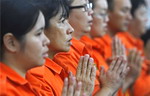
On Dec 26, Japanese Prime Minister Shinzo Abe visited the controversial Yasukuni Shrine, where 14 Class-A war criminals convicted in the Tokyo Trials are enshrined. Abe totally ignored the consequences of stepping into the shrine to offer his so-called prayers to the spirits of Japan's war dead. In fact, the visit was an act of homage to his spiritual belief, a strong impetus to Japan's right-wing forces, as well as a challenge to the victory against fascism and the post-war international order.
The Yasukuni Shrine is spiritual sustenance for Abe's right-leaning historical view. The shrine was established in 1869 and was originally named Tokyo Shokonsha (the shrine to summon souls). In 1879, it was renamed the Yasukuni Shrine. The Yasukuni shrine honors about 2.46 million Japanese war dead, all of whom are dead from wars of aggression fought worldwide throughout the history of Japan except about 14,000 who died during civil wars.
In 1978, the 14 Class-A war criminals were stealthily enshrined as "martyrs" for the country at Yasukuni. The shrine that honors the most heinous war criminals, such as Hideki Tojo, is not a religious site, but a "sanctuary" for right-wingers to summon the spirit of the dead war criminals. Abe's purpose in risking universal condemnation to visit the shrine was to seek a spiritual sustenance for "meeting the challenges without flinch and timidity".
His family inheritance is the genetic line of Abe's right-wing conception of history. Abe was born into the family of a war criminal. His maternal grandfather, Nobusuke Kishi, was a Class-A war criminal, who served in a key position in the cabinet of Hideki Tojo. Kishi was imprisoned as a suspected Class-A war criminal at the end of World War II but escaped being convicted and after being released, he still bore in mind the imperial dream of a "greater East Asia co-prosperity sphere".
Kishi became Japan's prime minister in 1957 and visited the Yasukuni Shrine soon after taking office. He was regarded as a ghost of Japan's past militarism and prewar political system. Abe's childhood was spent at Kishi's side. "Since my childhood, in my eyes, my grandfather was a sincere statesman who only thought about the future of this country," Abe wrote in his book titled Toward a Beautiful Country. Kishi is Abe's primary role model as a politician. Abe has proudly declared: "I am the son of Shintaro Abe but have inherited the DNA from Nobusuke Kishi."
While paying homage to the Yasukuni Shrine, Abe tried to defend the Class-A war criminals by claiming they are not criminals under the laws of Japan. Such shoddy performances are highly appreciated by Japanese hawkish and right-wing forces. Right-wing groups are the political basis for Abe's inherence in his right-leaning historical view.
The reason Abe dares to seek changes to Japan's Constitution, visit the Yasukuni Shrine and deny Japan's past militarism is that there are right-wing political forces and many right-wing groups that mastermind schemes and mass rallies for him.
It can be said that Japan's right-wing groups are the power source for Abe hanging on to his right-wing historical view.
Abe's obstinate insistence on his right-leaning historical view is surely leading Japan along a dangerous road. Abe has introduced his right-wing historical view into Japan's policymaking process. The Abe cabinet proposes amending the Constitution in a bid to break Japan's postwar pacifist tradition and expand the functions of its Defense Forces into a military.
In terms of its military buildup, the Japanese government has been increasing military investment and trying to abolish the "three principles on arms exports". In diplomacy, Japan with its uncompromising stand has made an issue of territorial disputes with its neighbors, resulting in continuous tensions with China, the Republic of Korea and Russia.
Guided by his right-leaning historical view, Abe has been constantly challenging the international order and continuously breaking through the bottom line of moral conscience after becoming prime minister again. What Abe has done and is doing under his right-leaning historical view will set the country on the path to ruin and is doomed to failure.
Only by taking history as a mirror can a country have a bright future. Making Japan a normal and powerful state will remain a fantasy if Abe and his cabinet persist with their right-leaning historical view.
Past examples should serve as a warning to later generations. If Abe remains impenitent and insists on his wrong historical view, which challenges human justice and hurts the feelings of people in its Asian neighbors, he is bound to put himself in the dock of history.
The authors are experts in Japanese studies with the Academy of Military Sciences.
 New type of urbanization is in the details

Copyright 1995 - . All rights reserved. The content (including but not limited to text, photo, multimedia information, etc) published in this site belongs to China Daily Information Co (CDIC). Without written authorization from CDIC, such content shall not be republished or used in any form. Note: Browsers with 1024*768 or higher resolution are suggested for this site.
License for publishing multimedia online 0108263 Registration Number: 130349