 |
| LI FENG/CHINA DAILY |
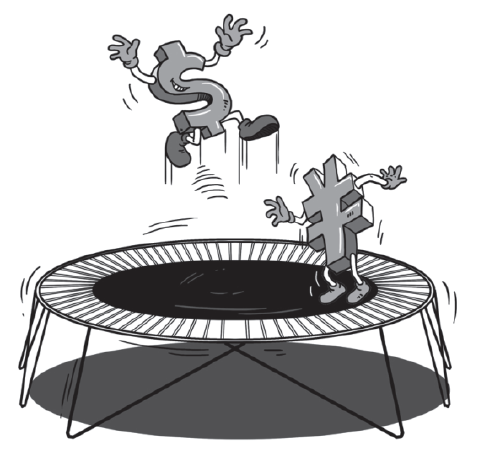
The exchange rate was about 6.05 Chinese Yuan (CNY) to the dollar in January 2014. As the US Federal Reserve ended its quantitative easing and began to prepare for rate hikes, the dollar began to rise. In August 2015, it was around 6.21 CNY to the dollar and, after the subsequent renminbi devaluation, 6.36.
But after late March, the renminbi began appreciating. Moreover, after the Chinese New Year, the exchange rate has largely correlated with the US Dollar Index, which measures the value of the dollar relative to a basket of foreign currencies.
The correlation is not a surprise. The basket of the US Dollar Index currencies accounts for some 70 percent of the weights in the Renminbi Index launched in December 2015. As the renminbi is now managed via a basket of currencies, China is not unilaterally driving the renminbi weaker-despite US election rhetoric.
Today, the exchange rate is about 6.57 CNY to the dollar. After hosting the G20 Summit, the renminbi will officially join the International Monetary Fund's international currency basket in early October. It is thus very much in Chinese interests to keep the renminbi stable.
From fall 2014 to spring 2015, the US dollar strengthened significantly, as evidenced by the US Dollar Index. In spring 2016, it declined somewhat.
In January, the Fed tempered rate hike expectations citing "global risks." In late February, the G20 countries agreed to move away from relying too heavily on zero-bound interest rate policies to support growth. After these two measures, the markets began to improve significantly.
However, rate hike speculation has returned in the past few weeks. As a result, economic uncertainty is increasing and market volatility climbing. However, that is not driven by the renminbi, but uneasy labor markets in the US, rising global uncertainty and the Fed's accompanying ambivalence.
If the Fed increases interest rates prematurely, the collateral damage will not be just domestic but global. In this scenario, the renminbi is not the appropriate culprit but a convenient scapegoat.
The author is the founder of Difference Group and has served as research director at the India, China and America Institute (USA) and visiting fellow at the Shanghai Institutes for International Studies (China) and the EU Centre (Singapore).



I’ve lived in China for quite a considerable time including my graduate school years, travelled and worked in a few cities and still choose my destination taking into consideration the density of smog or PM2.5 particulate matter in the region.
Copyright 1995 - . All rights reserved. The content (including but not limited to text, photo, multimedia information, etc) published in this site belongs to China Daily Information Co (CDIC). Without written authorization from CDIC, such content shall not be republished or used in any form. Note: Browsers with 1024*768 or higher resolution are suggested for this site.
License for publishing multimedia online 0108263 Registration Number: 130349