 |
|
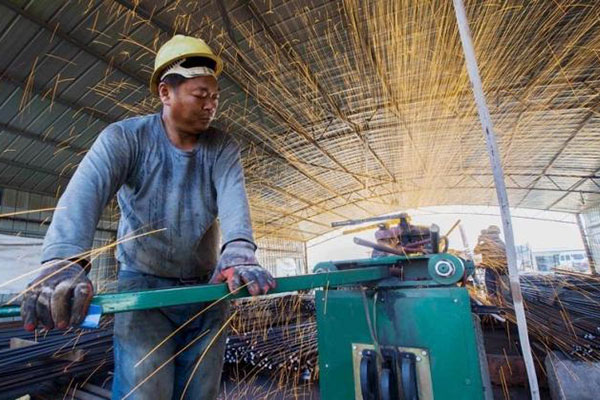
A labourer cuts steel bars at a railway bridge construction site in Lianyungang, Jiangsu province, September 12, 2015.[Photo/Agencies] |
An important mission of the supply-side reform is to reduce overcapacity, which is essential for the healthy development of the Chinese economy in the long run. The increase in labor cost and the other factors of production have not only weakened some conventional industries' advantages, but also worsened the overcapacity problem.
Yet reducing overcapacity does not mean eliminating conventional industries completely. So the reform should be carried out according to the specific conditions of specific places.
It is a remarkable that China took just 60 years to build a relatively complete industrial system while some developed countries took more than 200 years to do so. But since China's industrialization is not yet finished, the government still has to recognize the leading role of manufacturing in boosting economic growth.
Western countries implemented neo-liberal economic policies in the 1970s to pull their economies out of the quagmire of stagnation, which resulted in the large-scale relocation of conventional industries to developing countries, the idling of domestic industries and the decline of conventional manufacturing industries.
Before the global financial crisis of 2008, the share of manufacturing in many developed countries' industries was about 10 percent, with the service sector, mainly in finance, insurance, tourism, consultation and restaurants, accounting for more than 75 percent.
This de-industrialization of Western countries has had serious consequences. After the global financial crisis broke out, their economies declined fast and the growth in their citizens' incomes stopped or even fell. Investments became insufficient and exports dwindled, with stagnation becoming an almost normal phenomenon.
Drawing lessons from these countries, China should not support the survival of enterprises with overcapacity, which also pollute the atmosphere and have no scope of being upgraded. But the enterprises that can still be innovative and transform their production methods should be reformed.
Reducing overcapacity also means cutting conventional industries' operating costs, strengthening their comparative advantages and helping them upgrade their technologies.
Reform is an effective way of solving the overcapacity problem. But the market should be allowed to play a decisive role in the distribution of resources, because it can force enterprises to constantly improve their competitiveness. And the government should enact policies to ensure the process to reduce overcapacity is carried out in an orderly and rational manner.
As for the enterprises, they should pay attention not only to upgrading their technologies but also to moving up the value chain, transforming from the labor-intensive to tech-intensive model, and enhancing their core competitiveness.
The process to reduce overcapacity must also take the enterprises' economic and social capacities into consideration. Since China still needs to maintain a certain level of economic growth, it should take some measures to create a good macro-economic environment for reducing overcapacity. And it needs to follow a pro-active fiscal policy and a prudent monetary policy, in order to stimulate growth, boost consumption and expedite urbanization.
Moreover, the enterprises have to improve their products' quality and pursue innovation, especially because Chinese consumers' demand for high-quality and smart commodities has been increasing by the day. The government should take steps to bridge the development gap between different regions.
Also, since the Beijing-Tianjin-Hebei integration development plan, Yangtze River Economic Belt development plan and the Belt and Road Initiative, the Silk Road Economic Belt and the 21st Century Maritime Silk Road, are all related to the project of reducing overcapacity, there is need for China to foster international industrial cooperation and promote its competitive industries-such as steel, construction materials, high-speed railway, electricity, telecommunications, engineering machinery and ship-building-to enter the global market through investments, technological cooperation and equipment export, and by winning contracts.
The author is an economics professor of Nankai University in Tianjin.
The Chinese version of this article was first published by Qiushi Journal in its 10th issue of 2016.



Copyright 1995 - . All rights reserved. The content (including but not limited to text, photo, multimedia information, etc) published in this site belongs to China Daily Information Co (CDIC). Without written authorization from CDIC, such content shall not be republished or used in any form. Note: Browsers with 1024*768 or higher resolution are suggested for this site.
License for publishing multimedia online 0108263 Registration Number: 130349