 |
|
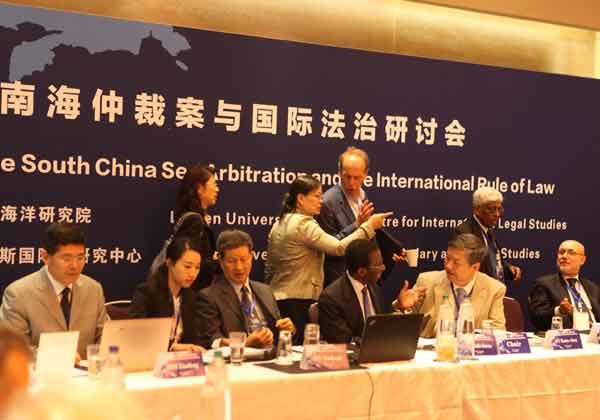
Leading international law experts said any verdict by the Arbitral Tribunal on the South China Sea will be of no legal validity, at a seminar on the South China Sea Arbitration and International Rule of Law in the Hague on June 26. [Photo by Fu Jing/chinadaily.com.cn] |
Expected on July 12, the ruling by the Hague-based arbitral tribunal on a case filed by the Philippines in 2013 will be ultra vires. It will also open a can of worms, triggering a floodgate of abusive lawsuits by many countries. It will take the luster off the United Nations Convention on the Law of the Sea's till-now growing cachet. More alarmingly, it will put peace in the South China Sea at risk, and potentially destabilize the astoundingly successful Asia-Pacific region.
And being ultra vires, the ruling will be null and void. UNCLOS specifically excludes from its jurisdiction all issues of territorial sovereignty and maritime demarcation, restricting itself to interpretation or application of its regulations. That the Philippines has camouflaged its case under the cloak of generation of entitlements to islands does not hide the fact that its dispute with China is indeed about territorial sovereignty and maritime demarcation. Legally speaking there is no dispute as Beijing and Manila have not even formally discussed the specific claims raised in the latter's submission to the tribunal.
Besides, Article 281 of UNCLOS clearly mentions that the convention applies only if the parties have not agreed to seek settlement of the dispute. While the Philippines has not formally discussed with China the claims it has submitted to the tribunal, it has jointly issued a series of bilateral agreements with China and signed the Declaration on the Conduct of Parties in the South China Sea, affirming that disputes will be settled through negotiations. The tribunal's opinion that the above does not constitute an agreement is deeply flawed.
The above ruling will not help Manila. Beijing has repeatedly made it clear it will neither participate in the proceedings nor accept the ruling. In fact, far from reaching an agreement with China over its disputes, the Philippines will only succeed in plunging its long friendly relations with the economic powerhouse to a nadir and lose the golden opportunity to develop its economy. It will also lose the chance to jointly develop with China many of the disputed areas in the South China Sea.
The ruling will also destabilize the South China Sea by encouraging its militarization. The United States has begun monitoring it with the help of guided-missile destroyers, even as it has deployed two aircraft carriers in the Philippine Sea.
China's Defense Ministry has termed the US' attempt to militarize the region as "miscalculating". There is always a chance of error and history provides ample examples of small incidents leading to major consequences. The Asia-Pacific region, brought to its knees by Japanese aggression in World War II, has taken 70 years to rise again and achieve unparalleled economic growth. It will be heartbreaking to see this reversed.
Manila has strengthened its relations with Washington. But Washington may have its own perceptions and misperceptions, especially in its post-"pivot to Asia" phase, which may not match the long-term interests of the Philippines. China's Ambassador to the US Cui Tiankai recently said China's maintaining of its legitimate position has been grossly misperceived as a strategic move by China to challenge US dominance. The US' responses to the Asian Infrastructure Investment Bank and the Belt and Road Initiative, the Silk Road Economic Belt and the 21st Century Maritime Silk Road, are similar examples of misperceived intentions. Cui could have added that misperceptions can turn into self-fulfilling prophecies.
What can be done now? The US' decisions to invade Iraq and Afghanistan and to intervene in Libya and Syria have destabilized the entire Middle East. Its recent egging of NATO to position itself on Russian borders is reckless. And its deployment of THAAD in the Republic of Korea and sending destroyers to patrol the South China Sea will destabilize the Asia-Pacific. Well-wishers of the US will want it to resume the role of a "wise leader" and jointly enact with China crisis management mechanisms and a more inclusive security structure to help maintain peace and stability in the region. And well-wishers of the Philippines would advise President Rodrigo Duterte to withdraw its case before it is too late and return to the negotiating table.
The author is a visiting faculty at Beijing Dublin International College at Beijing University of Technology.



Copyright 1995 - . All rights reserved. The content (including but not limited to text, photo, multimedia information, etc) published in this site belongs to China Daily Information Co (CDIC). Without written authorization from CDIC, such content shall not be republished or used in any form. Note: Browsers with 1024*768 or higher resolution are suggested for this site.
License for publishing multimedia online 0108263 Registration Number: 130349