 |
|
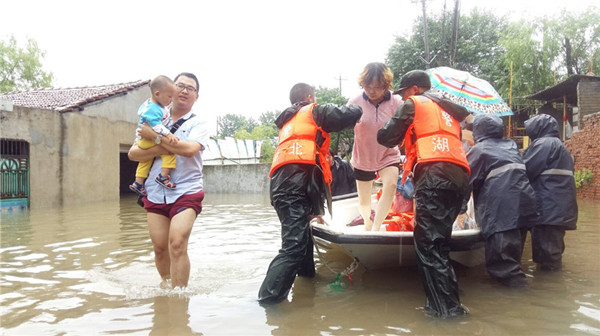
Soldiers rescue residents besieged by flood waters and help them into life-saving boats in Wuhan city, Hubei province on July 6, 2016. Hubei is one of the worst-hit provinces. [Photo/VCG] |
Large swathes of Central and South China have been hit by rainstorms and floods since June, reminding people of the massive floods of 1998 that claimed 1,800 lives and affected more than 100 million people in the Yangtze River basin. The current spate of floods, in all likelihood, will cause more economic damage than 18 years ago in the affected areas that include 11 provinces, regions and municipalities along the Yangtze River and Huaihe River.
Indeed, the disastrous floods of 1998 extended up to the Heilongjiang and Nenjiang rivers in Northeast China, and led to direct economic loss of about 248 billion yuan ($37 billion) that accounted for about 3 percent of that year's total GDP. The ongoing floods may not be as destructive in terms of the percentage of GDP today but the fact that the urban population has increased exponentially in the affected regions during the past 18 years means torrential rainfall will not only take a toll on rural areas and farmlands but also cause greater economic loss, compared with 1998, in major cities like Wuhan and Nanjing in Hubei and Jiangsu provinces.
Foreseeable hikes in the prices of agricultural products, following a bad harvest owing to natural disaster, could also lead to notable inflation in the second half of this year.
Home to at least 75 percent of the country's early rice fields, Central China's Hunan and Jiangxi provinces, as well as South China's Guangdong province and the Guangxi Zhuang autonomous region, have been hit hard by rainstorms and floods this year. In other words, these areas, along with worst flood-hit regions, will be unable to provide as much rice, cotton, vegetables and aquatic products as they usually do. The price of pork, too, is expected to rise as the scorching heat and continuous rainstorms have made pig-farming difficult.
Also, a significant rise in the prices of edible oil products has been felt across the country because of the waning production. True, the yearlong hike in food prices after the 1998 floods did not lead to severe inflation, because the Chinese economy had been under deflationary pressure following the Asian financial crisis in 1997. But the situation is different this time and the country could be exposed to greater inflationary risks.
There is good news, though, as the need for massive reconstruction when the floods subside will attract investors. In the aftermath of the 1998 floods, the central government generously subsidized the reconstruction of damaged houses in the affected rural areas, and initiated some six major water conservancy projects related to the Yangtze River as part of national debt.
The increase in the number of dams and other flood-prevention facilities has greatly contributed to the fight against floods since 1998. And nearly 50 billion yuan of investment in water conservancy in 1999 doubled the demand for cement, steel and machinery, giving a huge impetus to the country's economic growth in many years to come.
Likewise, after the 2008 Wenchuan earthquake in Southwest China's Sichuan province, investment in 10 fields, ranging from housing and infrastructure construction to disaster prevention, added up to almost 1 trillion yuan, 30 percent of which was from the central government's special funds. In this context, the lingering urban waterlogging problem could be solved for good, as governments at all levels are expected to double their financial support to fix the inefficient sewage systems in most big cities.
The author is a senior researcher at Suning Institute of Finance affiliated to Suning Appliance Co Ltd.



Copyright 1995 - . All rights reserved. The content (including but not limited to text, photo, multimedia information, etc) published in this site belongs to China Daily Information Co (CDIC). Without written authorization from CDIC, such content shall not be republished or used in any form. Note: Browsers with 1024*768 or higher resolution are suggested for this site.
License for publishing multimedia online 0108263 Registration Number: 130349