 |
|
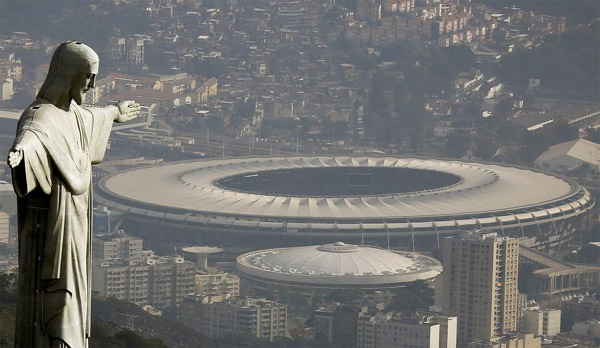
An aerial view shows the Christ the Redeemer statue with the Maracana stadium, where the opening cermony of the Rio 2016 Olympic Games will be held, in Rio de Janeiro, Brazil, July 16, 2016. [Photo/Agencies] |
Brazil has made great efforts as the host for the 2016 Olympic Games. One year after hosting the FIFA World Cup, this sequencing of events was seen as a unique opportunity to promote needed investment in infrastructure (transportation facilities in particular) as well as a window of opportunity to showcase Brazil's beauty and hence attract a good deal of tourists.
These are the main arguments that make countries dispute the honor of hosting big sports events. Nothing new, here.
The two sports galas have demanded a good deal of resources, if less than similar initiatives elsewhere. They have also motivated specific efforts to plan for the whole set of actions that such events require.
As it turns out, both events have contributed to improving in a substantive way the airports of those cities where the World Cup games took place. Even the Olympic Games are not taking place exclusively in Rio de Janeiro: other capital cities of several states are hosting specific events, and they had to prepare the needed infrastructure.
The whole process has not been free of criticism, though. Be it for the sheer size of some stadiums, or specific problems that remain in local transportation, or even the questions on the actual amount of money spent, which could have been invested in alternative social programs. This, of course, is not a Brazilian peculiarity, as these initiatives raise this type of criticism everywhere.
Be it as it may, the organizations of both the World Cup and the Olympic Games have been applauded in most appraisals. At least so far. The opening ceremony of the Olympic Games was a positive surprise, in the sense that it was quite different from the previous editions in other cities and that the organizers had much less resources than originally thought. Yet it was largely welcome.
As per the inheritance of the Olympic Games, it is now quite clear that the changes that took place in Rio de Janeiro in preparation for the World Cup are there to stay and are quite impressive. In the other capital cities the impact was less significant, since the matches there were held using the infrastructure built for the World Cup. As in other opportunities, the main hosting city will show the legacy of the Olympics. Very much like Barcelona and Beijing.
As far as the country's economy is concerned, however, it is not easy to pinpoint the actual gains stemming from the Olympic Games.
During the final stages of preparation for the Games, Brazil was experiencing a peculiar, unprecedented political situation (as it does even as the Games progresses). Also, and as part of the determining factors that have led to the political turmoil, there is a fiscal imbalance and the combination of these two elements inevitably affects expectations of the economic agents. As an outcome, the pace of economic activity is very low.
As it happens, indications are that the political situation might become clearer with the impeachment of President Dilma Rousseff, precisely by the time when the Games come to an end.
It is expected that once the political scenario becomes less blurred there might be a significant increase in investment (domestic and foreign), as well as better chances for the approval, by the National Congress (Brazil's top legislature), of a number of reforms that will help improve the fiscal situation.
As a consequence, the months following the end of the Olympics might be a period of business activities warming up, not exactly as a consequence of the Games, but due to the improvement of the overall political and economic environment. More directly linked to the divulgation of the Games, it is expected that the inflow of tourists will increase in the medium term.
Right now this is the main expectation and the biggest hope.
The author is an economist at the Institute for Applied Economic Research, and professor at Universidade de Brasilia, Brazil.

Copyright 1995 - . All rights reserved. The content (including but not limited to text, photo, multimedia information, etc) published in this site belongs to China Daily Information Co (CDIC). Without written authorization from CDIC, such content shall not be republished or used in any form. Note: Browsers with 1024*768 or higher resolution are suggested for this site.
License for publishing multimedia online 0108263 Registration Number: 130349