 |
|
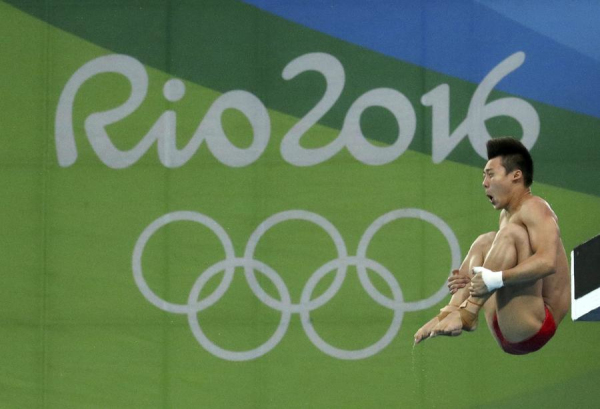
Chen Aisen of China competes in the men's 10m platform diving final in Rio de Janeiro, Brazil, August 20, 2016. [Photo/Agencies] |
The medals have been handed out, the flags raised and lowered for the last time, and in Britain the newspapers have indulged in a frenzy of praise after Team GB came second in the medals table, behind the United States but crucially, ahead of China.
That triggered a wave of disbelief on Chinese social media, with one netizen asking “Are you kidding?” on hearing the news that China had slipped behind the UK on the medals table.
Immediately, in both China and the UK, the focus has been on how the British did it, and what is the secret of the team’s success in gaining 27 golds, 23 silvers and 17 bronzes, beating China into third place with 26 golds, 18 silvers, and 26 bronzes.
Contrast that with the Atlanta Olympics in 1996, when Britain gained a solitary gold medal, coming a lowly 36th in the medals table.
Sir John Major didn’t get a lot of plaudits during his political career. But looking at the wreckage of Britain’s Olympic dream after the Atlanta debacle, as Prime Minister he took the decision to use the country’s wildly popular national lottery to fund high-performance sport, ensuring his place in history.
In the last four years alone, Britain has channelled 274 million pounds into summer Olympic sports and athletes, with another 72 million going to the Paralympic team. Three-quarters of that is lottery funded.
But UK Sport, which oversees the allocation of funding, has been ruthless in awarding success. Thus cycling, athletics and rowing have become major recipients, and it shows; every single member of the 11-strong cycling team took home a medal, and athletes took seven, while rowing gained five.
Initially China, whose 416 athletes were state-funded, was stunned at what many said was a below-par performance at Rio.
But a new theme has emerged in social commentary both inside and outside China.
Xinhua, the state news agency, took a cool look at the reasons behind Team GB’s emergence as an Olympic superpower.
National lottery funding, technological advances and scientific training combined to produce what Xinhua dubbed “the medal machine.”
It pointed out, not without a certain pride, that Team GB’s gold success in the synchronized springboard event was down to the hiring of coach Chen Wen, who once trained the Beijing diving team.
While some Chinese media have been harsh on China’s Olympic athletes, some UK commentators point out that China’s medal haul isn’t that bad.
Looking for solace, Xinhua pointed out what many Britons here have noticed, that there’s a new China emerging in terms of attitude.
For decades the stiff upper lip approach of the British in various sporting disasters, from soccer World Cup ignominy, to previous Olympic disasters has been the old adage, `It’s not the winning that counts, but the taking part.”
That attitude, which has been the theme of the modern Olympics since they began in 1896 in Athens, is based on founder Baron Pierre de Coubertin’s famous line “The important thing in life is not victory, but combat; it is not to have vanquished but to have fought well.”
The Olympics, staged as they are under the full scrutiny of 24-hour television and other media, have revealed a much more humane side to China’s competitors, embodied perhaps by swimmer Fu Yuanhui’s smiling and willingness to be honest about her performance in post-event interviews.
Television clips of Chinese coaches punching the air and embracing their charges, as well as uninhibited behaviour from the country’s fans, have also contributed to a picture of a warmer, more open China.
But don’t be fooled.
The next Olympics in four year’s time will be held in Japan, China’s arch regional rival. Given President Xi’s determination to make China a sporting power, be sure that whatever is needed to be done will be done.
Chris Peterson is Managing Editor, Europe for China Daily: chris@mail.chinadailyuk.com

 European cities serve models for China's urbanization

Copyright 1995 - . All rights reserved. The content (including but not limited to text, photo, multimedia information, etc) published in this site belongs to China Daily Information Co (CDIC). Without written authorization from CDIC, such content shall not be republished or used in any form. Note: Browsers with 1024*768 or higher resolution are suggested for this site.
License for publishing multimedia online 0108263 Registration Number: 130349