|
|
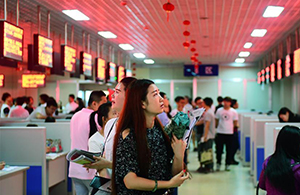
Ehizuelen Michael Mitchell Omoruyi is participating the events during retrace the steps of those brave Chinese soldiers through Yan’an in Shaanxi Province to commemorate the 80th anniversary of the Long March. [Photo provided to chinadaily.com.cn] |
As part of a group of foreign visitors that was invited to retrace the steps of those brave Chinese soldiers through Yan’an in Shaanxi Province to commemorate the 80th anniversary of the Long March, I discovered another part of rural China. Wuqi and Yanchuan Counties– the rich soil of Shaanxi province might not be as famous as other towns in China, but today both counties, and the small farming community in North East China’s, enjoy comparative serenity, unlike the period when it was under siege right before the epic Long March.
Both towns today are peaceful and provide business opportunities to both farmers and entrepreneurs. Visitors are warmly welcomed by friendly inhabitants to a serene atmosphere and pollution-free surroundings. Like most rural communities, both counties are devoid of the daily frenzied atmosphere and chaos in cities across China.
The people, like other rural people in China, are friendly. I am a living witness to the kind of reception a foreigner can receive when you visit Wuqi and Yanchuan Counties; this is as a result of the way we were treated. We were welcomed like royals with fruits, good spicy food that reminds me of home and unique Chinese tea which I kept drinking. However, the reception started before I got to Yan’an when Chen Ziyan, a China Daily staff was asked to assist me during my trip. She made the whole exercise a remarkable one; she gave me numerous reasons to believe that the spirit of the Long March was truly in her. She acted like the veterans that sacrificed everything for the China we see today.
It was a cold October morning at about 8am, when we were whisked along with other local organizers and media in one of the three buses on smooth highways through tunnels and bridges to witness one of the greatest epic treks in the history of mankind; the length of the journey they undertook eight decades ago has often been underestimated.
Although most of the buildings and sites have undergone some form of renovation, there were still indications of what the area looked like during the era the Red Army camped there. We visited two museums: one in Yanchuan County, the home of President Xi Jinping and the other in Wuqi County where items belonging to the leaders and soldiers of the revolution were carefully preserved.
The items breathe life back into the memories of the Long March struggles and the victory of 1930’s China. It displays how the embattled Chinese Communists broke through Nationalist enemy lines and begin an epic trek from their encircled headquarters in southwest China.
Looking at the pictures on the first day of our visit at the Wuqi Central Red Army Long March Victory Memorial Museum and Yanchuan Museum, I found it hard to visualize how much they must have suffered for their cause. It was there I discovered I was at the hub of China’s Great Revolution.
It was an epic journey; the journey lasted 369 days; though it was unintended, it did turn out to be a very Long March covering 6, 000 miles (9,650 kilometers); another author from Chinasage said the distance its almost twice the distance from New York to San Francisco. So, standing in the museum and looking at the various items that were displayed, I was reminded how the Long Marchers often had to cross difficult terrains like 24 rivers, 18 mountain ranges (5 snowy mountains), swamps and 11 provinces; it was an epic fight for survival for the Chinese Communists.
The total numbers involved in the march are hard to put down as many left and many joined the march along the way. Over 75,000 set out together with 20,000 non-combatants and only about 7,000 reached Yan’an. During the march, 236 days were occupied by day marches and 19 days by night marches; on average they took one day’s rest for every 115 miles covered.
It was estimated that 55 per cent were aged 16-23; 45 per cent 24-40; only 5 per cent were over forty years old. Only about a quarter were actually members of the Communist Party. Part of the Communist effort was to spread support, so leaving people behind to organize local resistance was part of the plan. Fatigue, hunger and sickness claimed many lives and only one-tenth of the force that left Jiangxi completed the Long March.
Based on the story the tour guide was telling us, it was now clear to me that among those that survive the march were almost all the high ranking communist officials in Chinese regime for the next six decades – Deng Xiaoping, Lin Biao, Mao Zedong and Zhou Enlai. As one of the surviving communist officials, Mao believed that during the Long March a powerful new weapon had been formed. The epic trek was inspirational, undeniable evidence of the superiority of men over weapons, and more broadly demonstrates the power of human will.
The epic event has inspired and guided the Chinese people, and it has by no means been easy for the Chinese people to improve their lives over the past eight decades. The hardworking spirit the world sees today in China is a result of the sacrifice from the Long March and it has never faded. The Long March spirit is with the Chinese people today as well as everyone who steps into China aiming to march towards their China dreams.
The march has gone beyond the boundaries of China; today, the Chinese development model and principle – informal as it may be – is quickly gaining momentum among developed and developing countries. Chinese investment is welcomed globally; according to research, this will soon place China to become one of the world’s biggest cross-border investors by the end of this decade, with global offshore assets tripling $6.4 trillion to almost $20 trillion by 2020. The Chinese model of development is exceptional in history and has made China assume a very significant position within the global economy. The veterans of the Long March gave an outward display of unity and solidarity that laid the foundation for the victory of the Chinese revolution and is regarded as the critical moment for Communist party.
This epic march shows that when shared hardship forged bonds of unbreakable loyalty and understanding, it can turn into wealth creation and redefined a nation. The tough journey had left a legacy not only to the Chinese people but to other nations struggling with conflicts. “Let China Sleep, for when the Dragon awakes, she will shake the world.” The saying is attributed to Napoleon and he seems to have been right.
The dragon is awake, and she is not going to take a great leap forward but instead is now on the long march; a march of victory. Today, China rightly remembers its heroes, whose bitter struggles would ultimately help build a steady, stronger, greater and better tomorrow for the Chinese generations of tomorrow.
Ehizuelen Michael Mitchell Omoruyi is a researcher from Institute of African Stuties Zhejiang Normal University



Copyright 1995 - . All rights reserved. The content (including but not limited to text, photo, multimedia information, etc) published in this site belongs to China Daily Information Co (CDIC). Without written authorization from CDIC, such content shall not be republished or used in any form. Note: Browsers with 1024*768 or higher resolution are suggested for this site.
License for publishing multimedia online 0108263 Registration Number: 130349