Strictly ruling the Party in an all-round way
 |
|
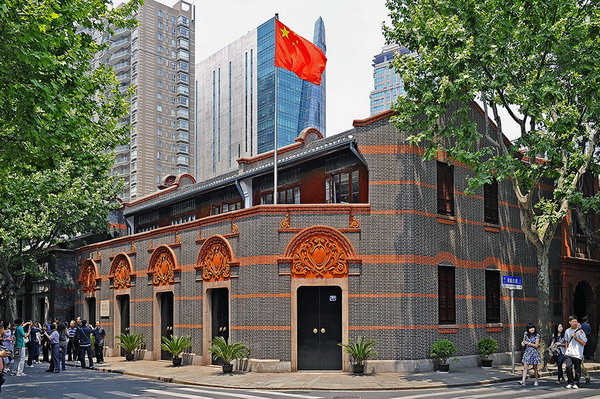
Tourists visit the Site of the First National Congress of the CPC in Shanghai. [Photo/VCG] |
The key to solving China's problems lies in upholding and strengthening the leadership of the country by the Communist Party of China.
As the country is still experiencing rapid economic growth and profound social transformation, the Party should enhance its construction and improve its governing capabilities. To do this, it should adhere to the Party strictly ruling the Party.
At the news conference given by the Standing Committee of the Political Bureau of the 18th CPC Central Committee in 2012, Party chief Xi Jinping, representing the new Party central leadership, said that sticking to the principles of the Party strictly ruling the Party, effectively solving the prominent problems of the Party, improving the Party's working style and ensuring it has close links with the people, were the responsibilities of the new leadership in order to ensure the Party is a strong core for Socialist cause with Chinese characteristics.
This is the Party leadership's understanding of national governance, as well as its solemn commitment to society.
Strictly ruling the Party in an all-round way is the fourth of Xi's guiding principles for governance known as the Four Comprehensives, and it has been incorporated into the Party leadership's national governance.
Starting from improving the working style of its members and resolutely carrying out the anti-corruption campaign, the Party leadership has made the construction of a clean government one of its priority tasks.
The Party leadership has shown its determination to fight against the four unhealthy working styles of formalism, bureaucratism, hedonism and extravagance, which have undermined people's trust in the Party.
The eight-point code of behavior it introduced struck at the four problems, which people were becoming increasinglly concerned about and critical of, and its effective implementation and enforcement of the eight-point code has been warmly welcomed by the public.
The Central Committee's resolve in ensuring the code and its setting an example for the whole of the Party have given the public more confidence in the Party and its rule.
It has dared to strictly "rule the Party in an all-round way", and in this way it has instilled confidence in its leadership.
And, in strictly ruling the Party, it has strengthened the awareness among Party members that they should be people-oriented and try to solve the problems that people are most concerned about. This is also an effective deterrent to unhealthy working styles and corruption.
The Three Stricts and Three Steadies campaign-that officials should be strict in cultivating their moral character, preventing abuse of power and in disciplining themselves; and steady in their planning of undertakings, starting of undertakings and in conducting themselves-has incorporated the proper working style of the Party into the practical work of the government down to the grassroots level.
At present, strategic deployment and systematic construction are the key tasks for the Party. It's high time the leadership's vision of clean governance became the consensus of the Party, which in turn would provide a solid ideological basis for improving the construction of the Party. On one hand, the Party's political culture and ecology need to be refashioned. On the other hand, construction of the Party organizations at the grassroots level, as well as the connections between Party members and Party organizations should be enhanced, as this would effectively incorporate the Party members into the Party's construction cause. After all, the Party is dependent on its members.
The author is director of the Center for Anti-corruption Studies, China University of Mining and Technology, Beijing.