Politics over market economy must end

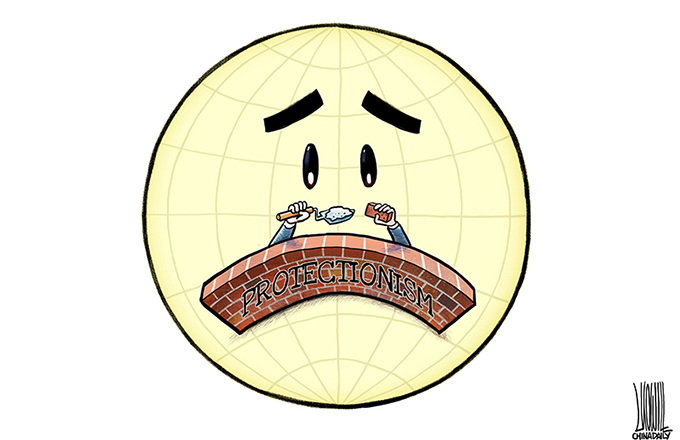
Whether or not the Unites States and the European Union will honor the commitment they had made when China acceded to the World Trade Organization 15 years ago will become a touchstone for the US and the EU leaderships' credibility.
In Section 15 of the Accession Protocol of China to the WTO, signed by all members including the US and China in December 2001, they agreed a 15 years' transition period to allow investigating authorities in other WTO members to use the analogue country method in their anti-dumping investigations against imports from China.
Under the analogue country method, investigators don't use the product price in the exporting country as a basis when determining whether to impose tariffs, and instead use third-country reference prices. As a result, more Chinese products are investigated, and in most cases they have to pay higher anti-dumping duties even though there are problematic issues related to price estimation in China.
From a strictly legal perspective, the Accession Protocol does not explicitly say that other WTO members should grant China market economy status and it does not set a deadline by which this must happen. In addition, the WTO itself does not have a definition of what exactly is a market economy. Domestic trade laws have created the concept of market economy status and the criteria to grant it.
But the protocol does say that "in any event" WTO members may not use the analogue country method against Chinese exports beyond the 15-year transition period. This means that after Dec 11, 2016, the US should treat Chinese exports like those from other WTO members, unless it renegotiates an agreement to prolong the transition period with China, which Beijing would not agree. So, whether or not the US confirms China's market economy status, from Dec 11 it will have to stop using the analogue country method against Chinese products.
Experts like Bernard O'Connor argue that other provisions of Section 15 imply that even after Dec 11, China will need to meet the market economy criteria of importing countries to stop other countries from using the analogue country method. This logic has two major flaws. First, if China still needs to prove it qualifies as a market economy after Dec 11, as O'Connor argues, then the expiry date in the protocol is meaningless. Second, the most likely intention of the negotiators writing this specific text was to allow for a 15-year transition period for both China and other members, during which China accepted discriminatory treatment in anti-dumping investigations.
More importantly, we are witnessing a degree of hypocrisy here from EU and US officials, who apply criteria to other countries that they themselves do not meet. No government intervention in productions and sales?
There are numerous cases where WTO panels have ruled against the EU and the US for their government interventions, including billions of dollars of subsidies to domestic civil aircraft manufacturing as well as cotton subsidies. CNN Money tracker shows the US government pledged $11 trillion and actually spent $3 trillion to rescue its financial institutions from 2008 to 2009, and the EU spent at least $1 trillion to bail out its banks.
Yes, China is still far from being a smooth-functioning market economy, although it has made steady progress in that direction. And it ought to continue improving its market institutions for the good of its own development.
But the fact that China falls short of a perfect market economy according to the US should not be an excuse for Washington to not respect the letter and spirit of the negotiated agreement of a 15-year transition period for the analogue country method.
Appropriate solutions to the issue could be an opportunity for US leaders to show that Washington remains credibly committed to standing by a rule-based, non-discriminatory multilateral trading system.
The author is managing director of ICTSD China.