Myanmar clash a threat to lives and trade
 |
|
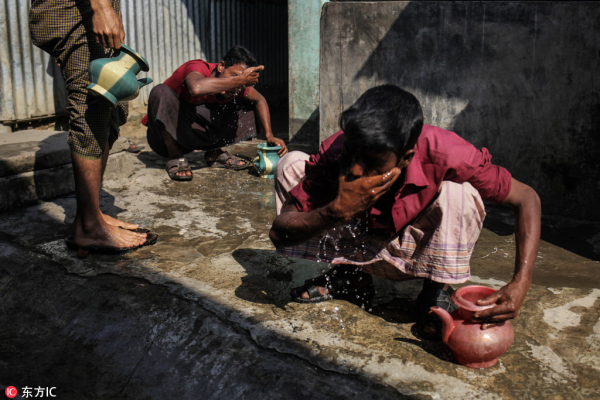
Myanmar Rohingyas are doing odhu before evening prayer at Leda Unregistered Rohingya Refugee Camp near Bangladesh, November 22, 2016.[Photo/IC] |
An alliance of some ethnic groups in the border area of northern Myanmar's Shan state launched a series of surprise attacks on Myanmar military outposts and police stations on Sunday morning. The clash between the armed attackers and security personnel has killed at least eight people and injured 29-nine policemen, two customs officers and 18 civilians.
Lodging representations with Myanmar after a Chinese national was hit by a stray bullet, China has urged all parties in the conflict to exercise restraint to prevent the situation from escalating further.
Judging by their combat capabilities and weapons in their possession, neither the government troops nor the ethnic armies seem capable of winning this conflict. They are more likely to be locked in a long-drawn confrontation. The new round of intense fighting points to a sore point in Myanmar's political dilemma-ethnic problems are far from being settled even after Aung San Suu Kyi's party assumed the highest office.
For years, the Myanmar government has sought to impose effective control on its resource-rich northern area, where local ethnic forces have also maintained an enduring presence. Fearing their interests would be infringed upon if they give up control over their territories, the ethnic forces including the Kachin Independence Army, Ta'ang National Liberation Army and Kokang's Myanmar National Democratic Alliance Army have little faith in the central government.
Racial hostility passed down from generation to generation, widening economic gap, and cultural isolation, too, have fueled the local armed groups' anti-government sentiment. And the Myanmar government has failed to effectively communicate and interact with the minority forces, some of which are non-signatories to the nationwide accord to end ethnic and other conflicts. That, to a point, explains why both sides have often misread each other's intentions.
The constant clashes in northern Myanmar also suggest that some ethnic armed groups still depend on the use of military tactics and separatism to defend their economic gains and political rights. The lack of communication has only worsened following the latest attacks, which the local forces said were launched to resist the government's recent military oppression in the affected areas.
In fact, both sides seem to wrongly assume that victories in armed conflicts will give them an advantageous position in peaceful negotiations. That has pushed a constructive consensus further off the table, adding more fuel to the longstanding hostility.
As a result, the national reconciliation process, which initially made good progress under the new government, has come to a halt with another round of finger-pointing under way. Besides, the conflicts have almost always spilled over into neighboring countries like China. Not only are Chinese nationals' security and assets under threat, but also cross-border trade exchanges face trouble. As of now, fleeing Myanmar people who have crossed the border and sought asylum in China have been taken care of, but China could be overburdened if they keep coming in.
As a key transit point for China-Myanmar commodity exchanges, the border trade zone in the affected Muse township is expected to play a bigger role in China's Belt and Road Initiative (the Silk Road Economic Belt and 21st Century Maritime Silk Road). Home to at least 70 percent of Myanmar's border trade, the township's trade volume reportedly was about $5.4 billion last year, a fourfold increase since 2011.
Endorsed by the China National Petroleum Corp, a crude oil pipeline linking the country's southwest and Myanmar's coastal city of Kyaukpyu is already in operation. These projects can be easily exposed to the volatile situation in northern Myanmar. So all parties involved should get back to the negotiation table as soon as possible and avoid causing unnecessary damage to Myanmar and neighboring countries.
The author is a researcher at the National Institute of International Strategy at the Chinese Academy of Social Sciences.