 |
|
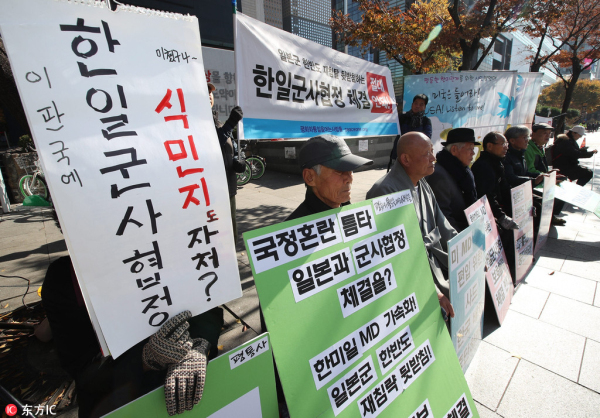
Activists hold a rally to denounce South Korea's signing of a pact with Japan on the sharing of military intelligence on North Korea, in central Seoul, South Korea, 15 November 2016. The two neighbors initialed the accord in Tokyo the previous day to better counter growing North Korean missile threats, despite strong public objection in South Korea.[Photo/IC] |
Japan likes to talk about the status quo. But the country itself is trying to shift the strategic balance of power in East Asia.
Following the example of the Republic of Korea, which has already decided to deploy the United States' Terminal High Altitude Area Defense, or THAAD, anti-missile system on its soil, Japan too is now seriously mulling the deployment of the system in the near future to build a three-tiered missile defense system.
"We are investigating future systems for intercepting missiles," Japan's Defense Minister Tomomi Inada said on Friday. She is expected to visit Guam next month to evaluate the THAAD system at the US base.
Japan's defense ministry has included research costs for THAAD in its budget request for fiscal 2017 in the name of improving the country's missile defense capabilities.
Japan's current two-layer ballistic missile defense system includes ship-based SM-3 interceptors that target missiles at high altitude and land-based PAC-3 batteries that aim to intercept missiles as they near the ground. Four of Japanese Maritime Self-Defense Force's six Aegis destroyers are currently equipped with SM-3 interceptors. Japan's defense ministry will upgrade the remaining two by fiscal 2018 and procure two more Aegis ships by fiscal 2020 to increase the total to eight.
The Yomiuri Shimbun reported that the ministry will set up a committee to begin full-fledged deliberations on THAAD. The new committee, which Japan's Deputy Defense Minister Kenji Wakamiya will chair, is supposed to come up with guidelines for antiballistic missile defense next summer.
According to The Japan Times, if the study confirms compatibility of the THAAD system and ground-based SM-3 interceptors currently operated by Japan, THAAD could be deployed during the country's next five-year defense buildup program starting in 2019.
The United States has urged its allies to adopt the system to guard against missiles launched by the Democratic People's Republic of Korea, which has launched more than 20 ballistic missiles so far this year.
The US, Japan and the ROK take the deployment of THAAD in Japan and the ROK as necessary, but China and Russia see no reason for that.
During Russian President Vladimir Putin's visit to Beijing in June, China and Russia issued a statement calling on nations to strictly abide by the norms of international law, keep their military capabilities at the minimum level required for national security and refrain from steps aimed at expanding existing military-political alliances.
The statement criticized the deployment of anti-missile systems in Europe and Asia, saying those who deploy them often acted under false pretenses.
On Wednesday Japan and the ROK signed their General Security of Military Information Agreement, or GSOMIA, under which the two countries will share defense secrets.
The US believes that the move will help the three sides finally build a security triangle.
The ROK's opposition parties are criticizing the GSOMIA, however, for helping Japan become a major military power.
As John Feffer, director of Foreign Policy In Focus, said in an article published in the Huffington Post in May 2015, the way to address the DPRK's nuclear and missile programs is to sit down and negotiate limits.
"Instead of letting Lockheed Martin determine the security politics of Northeast Asia, it's crucial to bring the diplomats back to the negotiating table to address the causes of insecurity and not just the symptoms," Feffer said.
THAAD has turned out to be a wedge driven between China and the ROK.
As some analysts have warned, if Japan also deploys THAAD, the US-led missile defense network in the Asia-Pacific would turn the region into the front of a new Cold War.
The author is China Daily Tokyo bureau chief.
caihong@chinadaily.com.cn


Copyright 1995 - . All rights reserved. The content (including but not limited to text, photo, multimedia information, etc) published in this site belongs to China Daily Information Co (CDIC). Without written authorization from CDIC, such content shall not be republished or used in any form. Note: Browsers with 1024*768 or higher resolution are suggested for this site.
License for publishing multimedia online 0108263 Registration Number: 130349