Fight against non-communicable disease
 |
|
LIU XINYI/CHINA DAILY |
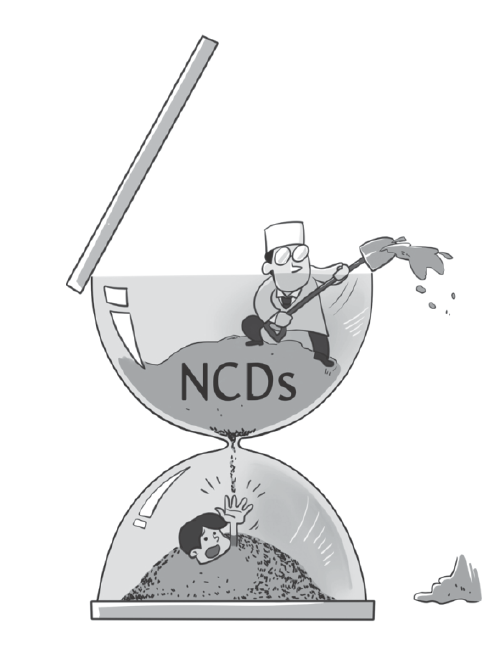
Global health organizations and initiatives-in particular, the World Health Organization-h(huán)ave traditionally focused on infectious diseases, from malaria (their great failure) to smallpox (their greatest success). But there has long been a tiny corner of global health that has targeted chronic non-communicable diseases (NCDs) in low-and middle-income countries. As these countries make progress on development, pressure to expand that corner is mounting.
The WHO started paying attention to NCDs in the 1970s, when it launched its first programs to reduce cardiovascular disease. By 1977, the organization had a designated NCD division. In 1985, the World Health Assembly adopted resolution WHA 38.30, calling for member countries to elaborate new strategies for addressing their NCD problems.
Two programs were initiated: one serving Western Europe and another, called Inter-Health, which focused on a mix of countries, from Chile and Tanzania to Finland and the United States. The goal of Inter-Health was to coordinate a set of experimental local projects, in order to develop a flexible program template applicable to countries at different stages of development.
It was a step in the right direction. But, for years, it was pretty much the only step the WHO took on NCDs in low-and middle-income countries. Then, in 1993, the World Development Report, and the subsequent Global Burden of Disease Study, quantified the extent of the NCD problem in low-income countries. It was a breakthrough for NCD activism.
The WHO responded to that breakthrough-and the criticism it triggered-with major reforms. By leading a growing advocacy coalition (in which the journal The Lancet played a central role), the WHO established itself as a leader in the fight against NCDs. The high point was the special United Nations meeting in 2011 devoted to NCDs.
But all these efforts have produced only mixed results, because NCD funding has only just kept up with overall global health funding-just 1-3 percent (depending on who is counting) of total development health assistance. As such, most governments in low-income regions appear to have done relatively little to address NCDs.
However, NCDs in low-and middle-income countries have lately been getting more attention. The 2013 Global Burden of Disease Report identified NCDs as the dominant health problem everywhere except Sub-Saharan Africa. More recently, a report by the Council on Foreign Relations indicated that mortality from NCDs for people under 60 is more than three times higher in low-income countries than in high-income countries.