Which way will supervision reform move?
 |
|
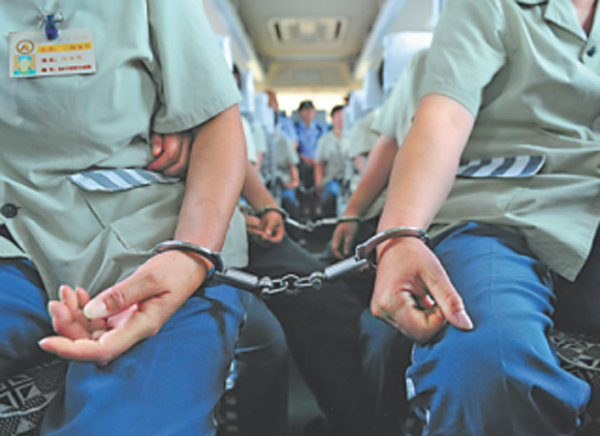
Criminal justice: Felons convicted of serious corruption would be prohibited from seeking shorter sentences, under a third reading of the draft amendment to the Criminal Law. The amendment aims to "safeguard judicial fairness".[Photo/China Daily] |

China launched a pilot program for supervision reform in Beijing, Shanxi and Zhejiang provinces in November with the aim of setting up anti-corruption bodies established by provincial-level people's congresses that will jointly work with Party disciplinary committees at the same level.
The effort to combine different tools and institutions to combat corruption is a welcome move as it will not only put more officials under supervision but also strengthen supervision, making the fight against corruption more efficient and authoritative. The pilot program will move from "strictly regulating Party members" to "strictly regulating all civil servants", including non-Party members.
For long, Party disciplinary committees at various levels have played the key role in preventing and curbing corruption, by mainly educating Party members to stay clean and launching investigations against those suspected of corruption. The method has been effective, but it has two problems.
First, most of the Party members are honest and principled; only a few are corrupt. So it will be a big waste of anti-corruption resources if disciplinary committees target only Party members. And second, some officials who are not Party members, too, could abuse their powers. So it is equally important to prevent non-Party-member officials from falling to the lure of corruption. However, the Party disciplinary bodies can hardly do anything against them because they are not Party members.
Corruption happens when people who wield power are not supervised or monitored, no matter whether they are Party members or not. Therefore, the disciplinary supervision bodies should oversee all civil servants, rather than just Party members.
The existing government supervision organizations have tried to plug the loopholes by also monitoring officials who are not Party members. But in the past they were not given enough power and their duties were rather limited. As a result, most of the corruption cases involving non-Party members were detected by procurators rather than government supervision bodies in the past.
That's why the reform is necessary. The anti-corruption committees established by the provincial-level people's congresses have more power and their official level is the same as that of the judiciary.
More importantly, the new committees have the power to supervise all public servants, as is clearly stated in the pilot scheme. All employees in government agencies, public funded institutions and State-owned enterprises are subject to the supervision of the new committees.
And the fact that the new committees will work with Party disciplinary committees at the same level shows the reform is aimed at making fight against corruption more efficient. Since many officials are Party members, both committees are authorized to supervise them; and by working together, they will avoid repetitive work and cannot shirk responsibilities.
Besides, there are multiple departments that can supervise officials, and their efforts need to be integrated under the leadership of the Party, so as to more efficiently combat corruption. Of course, the design needs to stand the test of practice and time, and that's why the program is on a dry run in Beijing, Shanxi and Zhejiang. Hopefully, it will provide precious experience to strengthen the future fight against corruption.
The author is a professor of anti-corruption studies at the Zhou Enlai School of Government, Nankai University.