Tsai's trip will not serve intended purpose
 |
|
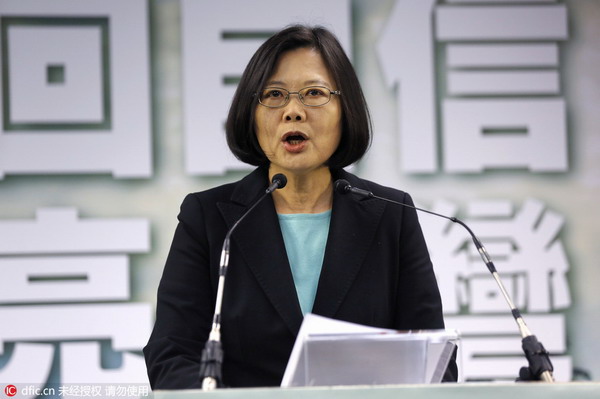
Taiwan's main opposition Democratic Progressive Party, DPP, Chairperson Tsai Ing-wen speaks during a press conference in Taipei, Taiwan, Wednesday, April 15, 2015. [Photo/IC] |
A week before Taiwan leader Tsai Ing-wen travels to Latin America, Zhang Zhijun, head of the mainland's Taiwan Affairs Office, said in his New Year's message that the Chinese mainland will share development opportunities with Taiwan while firmly opposing "Taiwan independence" activities.
Tsai's weeklong trip to Latin America from Saturday will take her to Honduras, Nicaragua, Guatemala and El Salvador, with stopovers in Houston and San Francisco in the United States. Her visit is aimed at strengthening the island's "diplomatic ties" with 21 countries, mostly in Latin America and the Caribbean, after losing the African island nation of Sao Tome and Principe, which resumed diplomatic relations with Beijing last month.
The mainland has exercised utmost restraint despite knowing the Tsai administration will ignore the 1992 Consensus while seeking to maintain relations with its "diplomatic allies". In fact, the mainland has given the island enough time to finish the "incomplete test" and put cross-Straits relations back on the right track, without wounding its "political dignity".
However, judging by what she and her Democratic Progressive Party have said and done over the past seven months, Tsai has failed to see the big picture that is so clear to the mainland. On the contrary, she remains noncommittal on the one-China principle, the political bedrock of cross-Straits ties, and is poised to wade into uncharted waters.
Gimmicks like calling US president-elect Donald Trump to congratulate him on his victory will not help Tsai to end the island's "diplomatic" predicament. Instead, they will add to the risk of exacerbating the already strained relationship between the mainland and Taiwan.
Thanks to the arrangements based on the one-China principle and UN Resolution 2758, which recognizes the People's Republic of China as the sole representative of the country, the island can take part in international events that suit its status. Should it seek to overstep the boundaries, normal relations with the mainland would be a pie in the sky.
In essence, Taiwan's "money politics" cannot last long, especially because its economy has been struggling to pick up. Urged to tighten the island's "diplomatic" budget to improve people's livelihoods, Tsai had promised to stop offering one-sided financial aid to the island's so-called overseas allies after she assumed office in May.
But money matters in diplomacy. For example, Sao Tome and Principe severed its ties with the island, ostensibly because of the latter's failure to fulfill the demand for $210 million "gift money"-$70 million as instant donation and $140 million as low-interest loans.
The same could happen with Taiwan's remaining 21 "allies". Even when the disruptive Chen Shui-bian was the island leader between 2000 and 2008, the money-wielding trick did not stop six "allies" from breaking away from Taiwan. So, it is not impossible for the island to lose all its other "friends".
Siding with the United States is equally unlikely to help the island, as Washington cannot afford to sever its diplomatic ties with Beijing. It would be political immaturity on the part of Tsai to misinterpret or underestimate the mainland's determined pursuit of peaceful reunification.
The author is a professor at the Institute of Taiwan Studies, Beijing Union University.
Tsai's weeklong trip to Latin America from Saturday will take her to Honduras, Nicaragua, Guatemala and El Salvador, with stopovers in Houston and San Francisco in the United States. Her visit is aimed at strengthening the island's "diplomatic ties" with 21 countries, mostly in Latin America and the Caribbean, after losing the African island nation of Sao Tome and Principe, which resumed diplomatic relations with Beijing last month.
The mainland has exercised utmost restraint despite knowing the Tsai administration will ignore the 1992 Consensus while seeking to maintain relations with its "diplomatic allies". In fact, the mainland has given the island enough time to finish the "incomplete test" and put cross-Straits relations back on the right track, without wounding its "political dignity".
However, judging by what she and her Democratic Progressive Party have said and done over the past seven months, Tsai has failed to see the big picture that is so clear to the mainland. On the contrary, she remains noncommittal on the one-China principle, the political bedrock of cross-Straits ties, and is poised to wade into uncharted waters.
Gimmicks like calling US president-elect Donald Trump to congratulate him on his victory will not help Tsai to end the island's "diplomatic" predicament. Instead, they will add to the risk of exacerbating the already strained relationship between the mainland and Taiwan.
Thanks to the arrangements based on the one-China principle and UN Resolution 2758, which recognizes the People's Republic of China as the sole representative of the country, the island can take part in international events that suit its status. Should it seek to overstep the boundaries, normal relations with the mainland would be a pie in the sky.
In essence, Taiwan's "money politics" cannot last long, especially because its economy has been struggling to pick up. Urged to tighten the island's "diplomatic" budget to improve people's livelihoods, Tsai had promised to stop offering one-sided financial aid to the island's so-called overseas allies after she assumed office in May.
But money matters in diplomacy. For example, Sao Tome and Principe severed its ties with the island, ostensibly because of the latter's failure to fulfill the demand for $210 million "gift money"-$70 million as instant donation and $140 million as low-interest loans.
The same could happen with Taiwan's remaining 21 "allies". Even when the disruptive Chen Shui-bian was the island leader between 2000 and 2008, the money-wielding trick did not stop six "allies" from breaking away from Taiwan. So, it is not impossible for the island to lose all its other "friends".
Siding with the United States is equally unlikely to help the island, as Washington cannot afford to sever its diplomatic ties with Beijing. It would be political immaturity on the part of Tsai to misinterpret or underestimate the mainland's determined pursuit of peaceful reunification.
The author is a professor at the Institute of Taiwan Studies, Beijing Union University.