Spring Festival brings China into focus
 |
|
Tourists visit the Ruins of St. Paul's in Macao, South China, on Feb 1, 2017, during China's Lunar New Year holiday. [Photo/Xinhua] |
Many people in China regard the vogue for celebrations at Christmas and Thanksgiving Day as an invasion by Western culture.
Yet, these same people acclaim the popularity of Chinese Lunar New Year celebrations in recent years as evidence Spring Festival is now a world festival and hail it as a sign of the rise of China and its increased national power.
To some extent, people worried about the celebration of Western festivals in China are overreacting, likewise with their promoting of Spring Festival as a symbol of China's power.
Certainly the Chinese diaspora means there are Chinese communities in many countries around the world that celebrate the festival.
According to statistics of the government's Overseas Chinese Affairs Office, the number of overseas Chinese has risen from about 5 million in the early 20th century, when more than 90 percent were settled in Southeast Asia, to more than 60 million in 198 countries and regions now.
And the wide distribution of Chinese overseas constitutes a solid foundation for the transformation of Spring Festival from a community celebration into a worldwide festival. Especially as celebrating the 4,000-year-old festival provides foreigners with a chance to gain an insight into Chinese culture and traditions, which many foreigners are curious to learn more about now that the country has taken a more prominent role on the world stage.
Foreign media outlets have catered to this curiosity by reporting on topics related to the festival, not only its background and characteristics but also how it brings into sharp relief the changing nature of the festival and Chinese society.
Although its growth rate is obviously lower than its peak just several years ago, China's economy is still growing at the fastest rate among all major economies, and its remarkable performance means that in recent years more Chinese families have been traveling overseas during Spring Festival, Japan being just one of the countries whose economy has benefited from the trend.
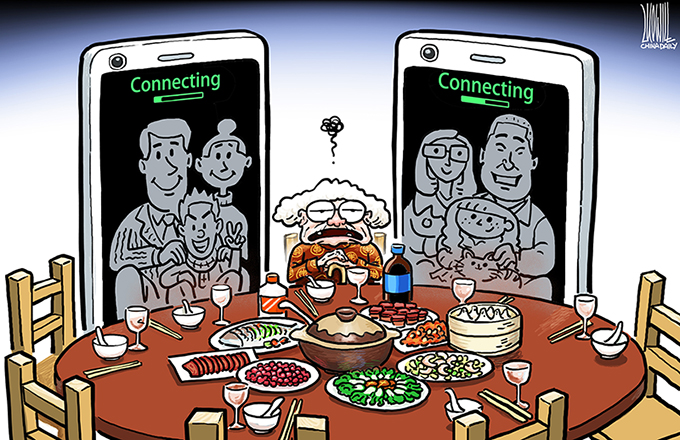
However, the festival also highlights some of the problems confronting the country today as a result of its phenomenal growth over the past 30-plus years. For instance, the famous Spring Rush of migrant workers heading back to their hometowns to celebrate the Lunar New Year with their parents, and often their children that have been left behind, brings home the need for the government to press ahead with the reforms it has set out and the urbanization drive.
Indeed the celebrating of the Chinese Lunar New Year spread around the world without war or commercialism, along with waves of Chinese migrants. They were not invaders and colonists, but merchants and coolies at first, who then improved their life through generations of hard work and education. In many countries, the Chinese communities are role models, and the values they represent, for instance, harmony and cooperation, are particularly pertinent to people's needs today.
In fact, the increasing popularity of the Chinese Lunar New Year overseas is only a by-product of the contribution of Chinese to the world.
Chinese President Xi Jinping's visits to other countries and his speeches on key occasions, such as the one he made at the World Economic Forum in Davos, Switzerland, last month, have raised China's profile as a modern country, confident in its own development path and culture.
Against this backdrop, Spring Festival, as the most important traditional Chinese festival, can be regarded as having taken a ride on China's raised profile.
The author is a writer with China Daily. liyang@chinadaily.com.cn