US resumes its provocative actions in sea
 |
|
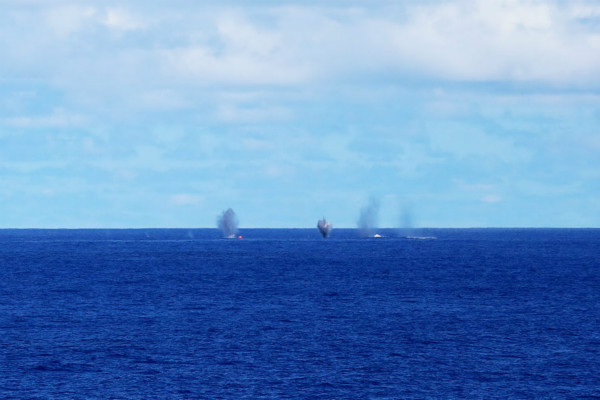
Missile destroyers Changsha and Haikou, part of the Chinese Navy's Nanhai Fleet, fire at simulated enemy destroyers during a counter-attack drill in the South China Sea on Feb 19, 2017. [Photo/Xinhua] |
The USS Carl Vinson Nimitz-class carrier strike group has begun patrolling the South China Sea, proving the speculation over the past few days was true. On Feb 12, the US Navy Times reported that the United States Navy was planning to dispatch warships to the South China Sea for "freedom of navigation" operations-in a move apparently meant to challenge China's sovereignty claims over some islands and reefs in those waters.
In response to the US Navy's anticipated provocative move, Chinese Foreign Ministry reiterated China's indisputable sovereignty over the South China Sea islands and adjacent waters. Beijing has consistently respected every country's right to freedom of navigation and overflight in the South China Sea in accordance with international law, but it firmly opposes any country's attempt to undermine China's sovereignty and security.
Despite China's strong opposition, the US Navy announced the nuclear-powered USS Carl Vinson began "routine operations in the South China Sea" on Saturday. This is the first time after the inauguration of Donald Trump as US president that a US Nimitz-class carrier strike group has sailed into the South China Sea.
Thanks to the joint efforts of China and members of the Association of Southeast Asian Nations, the situation in the South China Sea had started to stabilize.
Given this important fact, any responsible power should have welcomed the development and made efforts to help the different parties maintain the positive momentum.
But the US has its own agenda. By dispatching the USS Carl Vinson to the contentious waters, the Trump administration has signaled that it has no intention of respecting the regional countries' efforts to maintain peace and stability in the South China Sea.
Yet by doing so, the US has made the international community realize that its so-called freedom of navigation operation is nothing but an effort to hide its real intention.
In a white paper on its military strategy, published in May 2015, the Chinese government made it clear that its military pursues a defensive defense strategy but will not be cowed: "China does not offend others if not offended, and will surely offend others if offended". And in 2016, the Chinese navy declared that it is not afraid of any military provocations and that all attempts to make China succumb to military power will fail.
Some may argue that by sending warships or aircraft to the South China Sea, the US only wants to show off its military might and disturb China's resolve to safeguard its sovereignty and security. Others may say Washington's provocative actions in the South China Sea are mainly aimed at creating trouble for China in order to disrupt the pace of its peaceful development, and maintain the US' sole superpower status. Both arguments seem reasonable but do not reflect the full picture.
By sending the USS Carl Vinson to the South China Sea, the Trump administration has sent a clear message to the international community that it will carry forward the pivot to Asia strategy of former US president Barack Obama, which is aimed at containing China's rise and maintaining the US' hegemonic status in Asia, indeed the entire world. The US administration could also repeatedly use the South China Sea issue as an important chip to force China into making more concessions during bilateral talks.
Besides, there is no reason to believe the USS Carl Vinson will be the only card Washington plays in an attempt to exhibit its military strength in the region. So, China should be well prepared to play a "protracted game" with the US in the South China Sea. More important, Beijing should not make any unprincipled concessions that may allow outside forces to use the South China Sea issue as a chip to blackmail China.
The author is an associate professor at the PLA Navy's Dalian Warship College.