Profiles
Keeping it quiet: Life as an HIV carrier
(China Daily)
Updated: 2009-12-07 09:49
 |
Large Medium Small |
|
 |
Gao Xianmei says she does not remember the date when she was diagnosed as HIV positive. There have been more important things to keep track of since that dark day, most of all, hiding it from others.
"If others know I am an HIV carrier, my whole family will be humiliated," says the 35-year-old farmer in Guangxi Zhuang autonomous region.
Since China reported its first AIDS case in 1985, the world's most populous nation has recorded 319,877 HIV infections, including 49,845 deaths by October, according to the Ministry of Health.
Yet, the statistics only include cases reported by medical facilities. The ministry and the UNAIDS estimate that China has 560,000 to 920,000 HIV carriers, with 97,000 to 112,000 AIDS patients by the end of this year.


Gao was infected with HIV by her husband. When she got married in 2003, Gao, who was handicapped in early childhood, heard on their wedding day from her brother that her husband was an intravenous drug addict.
Her husband later confessed that he started using drugs when working in neighboring Guangdong province in the late 1990s. Gao did not expect anything worse would come along, though.
Drug abuse is not rare in Gao's hometown of Hezhou, which lies on a major drug-trafficking route of China from southwestern Yunnan province to Guangdong, the country's economic powerhouse.
In April last year, Gao's husband was diagnosed as HIV positive. Having no courage to tell Gao, he hid his medicines in the bushes around their house.
"I was stupid. I thought he might have cancer when a lump appeared on his neck. His little brother died of AIDS in 2005. My husband had the same symptoms," says Gao.
Her husband finally admitted his illness, begging for her forgiveness, when Gao tried to take him to the hospital for a cancer examination.
Gao remained calm. "I told him that he must get treated. It's no use blaming him. Nobody wants to have the disease," says Gao.
On the way to her own HIV test, Gao became desperate at the idea that she might have been infected.
"The one hour ride from our village to the hospital was so long. I kept thinking of our two daughters. The older one was only 2, the other was about 1. They were too young to become orphans," Gao says.
The "sentence" was handed down in a week. Gao was HIV positive, too. Her fragile desire to live on was preserved when doctors said her daughters were not infected.
Despite Gao's efforts to guard her secret, gossip about the couple spread in the village. Most neighbors started to keep a distance from her family. People's cold looks and indifferent tone filled her with shame and remorse.
Deputy Director of the Hezhou Center of Disease Control (CDC) Chen Yihai has been observing the pains of HIV carriers such as Gao. "They are confronted with great pressures. Discrimination sometimes comes from both the family and the community. They have to hide the pain deep in their hearts," says Chen, who has been involved in HIV/AIDS prevention for more than 10 years.
Gao seldom looks back at her life with regret or bitterness. "Time only sharpens my desire to live on," she says. But she cannot ignore the financial difficulties of her six-member family, whose average annual income is less than 6,000 yuan ($882).
Although the government covers more than 70 percent of the cost for the couple's regular treatment, the family is heavily in debt as Gao's husband is too weak to work, and she needs medicines to keep her immune system functional.
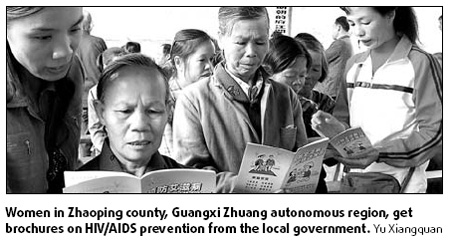
To help women with HIV like Gao, the Hezhou CDC has been offering them psychological and financial support with UNICEF China since 2007. An organization called Red Lotus Group has been established to provide loans and medical counseling to HIV/AIDS-affected families. It also organizes outdoor activities for its members to help them release pressure.
The Red Lotus now has more than 500 members. Gao joined the group last year and applied for a one-year, interest-free loan of 3,000 yuan ($440) this January.
She used the money to raise pigs, and grow yam and other vegetables. She hopes that her family income will double this year and plans to borrow more money next year to raise more pigs.
"It's quite pleasant to talk with other Red Lotus members. We face similar problems, so we can understand each other. There is no need to hide our feelings," says Gao.
She is now more hopeful about the future. "I hear that the medicines to cure AIDS will be developed soon. I hope I can be cured before my daughters are old enough to understand my disease. I want to see them get married and prepare their dowries myself," she says with a wistful smile.
Xinhua