Profiles
Doctor worth his weight in gold
By Lei Lei (China Daily)
Updated: 2010-02-11 07:18
 |
Large Medium Small |
Specialist helps elite athletes recover on their way back to the top
Since learning how to swim at the age of six, Chen Fangcan has immersed himself in sport.
From an athlete, a sports major in university and coach to a doctor of physical therapy, 51-year-old Chen has never left the field, whether in China or the United States.
|
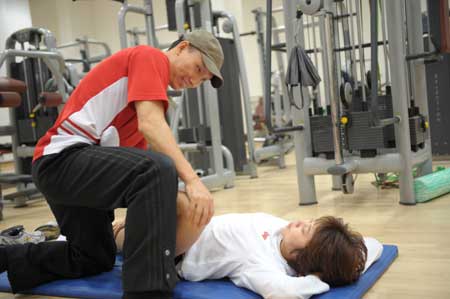 Chen Fangcan, a physical therapist, guides an athlete in training. [Courtesy of Chen Fangcan] |
He now works as a physical therapist for national sports teams and elite athletes in China, keeping them healthy en route to the top of the podium.
"Being able to help others is very enjoyable," Chen told China Daily. "I love working with these dedicated athletes."
The big names that have overcome injuries because of his help include two-time badminton women's singles gold medalist Zhang Ning, multiple world and Olympic gymnastics champion Li Xiaopeng, China's men's swimming ace Zhang Lin and women's tennis Grand Slam doubles winner Zheng Jie.
"Dr Chen helped me a lot in my physical therapy. I always like to go to him for help after training," said Zheng.
Born in southern Guangxi Zhuang autonomous region, Chen was first trained as a swimmer and became a water polo player seven years later.
Born with ear problems that forced him to live with a hearing aid, Chen gave up the idea of being a professional athlete and entered Beijing Physical Education University in 1978. After graduating, he went back to his hometown to coach the provincial water polo team and led the team to the crown at the fifth National Games in 1983.
He could have remained a successful coach there, but he realized he still hadn't learned enough to push the team even further.
"I love the sport very much, so I wanted to make more contributions to my team. I realized I needed to learn more if I wanted to achieve better results," Chen recalled.
He then went to the US to pursue a masters degree in sports biomechanics and kinesiology in 1985.
During his 11 years of study in the US, he also obtained a doctors degree in sports medicine and biomechanics and passed the certification for physical therapy. He was invited by New York University to be a professor there in 1996.
"My studies in the US were very difficult, since I had to work part-time to earn money to support myself. But the experience was very important for me," said Chen.
The rise of China as a sports powerhouse in the 1990s aroused Chen's attention and further strengthened his determination to return to China.
"After the 1996 Atlanta Olympic Games, (in which China claimed 16 gold medals, 22 silvers and 12 bronzes), I noticed that although China achieved remarkable results, the Western media still held a bias against China's sports. I was always asked: 'What drugs have Chinese athletes taken?' This made me very uncomfortable," said Chen.
"It's time for me to do something for Chinese athletes to let Western people know they accomplished this through scientific training, not drugs."
The opportunity came in 2001 when Beijing won the right to host the 2008 Olympic Games. The following year, he received an invitation from Hong Kong Polytechnic University and brought his research back to Beijing to work with many Chinese national teams, including swimming, diving, basketball, badminton and gymnastics.
His dormitory in the experts' building of the State General Administration of Sports is filled with therapeutic machines and is more like a treatment room than a living room.
At present, Chen has moved his "working room" to the training base of China's winter sports in the Capital Stadium, where he can help Chinese athletes who are preparing for the upcoming Vancouver Winter Olympic Games.
He has already helped half-pipe snowboarder and medal hopeful Liu Jiayu recover from an injury in time for the Games.
But he still has a long-term plan to continue giving Chinese sports a helping hand.
"Now, I'm preparing to set up a training base for retired Chinese athletes," Chen said.
"There is a great demand for physical therapists in China, so I hope to train more retired athletes to become qualified sports doctors. It will benefit both professional athletes and even average people who need treatment."