Huge number of cultural collections and exhibits draws 1 million visitors from home and abroad each year, Zhang Zhao reports.
Since its opening in 2010, the relocated Shandong Museum has welcomed more than 1 million visitors from home and abroad each year. With prominent exhibits, advanced equipment and first-class service, the museum has become a major platform for cultural exchanges in Shandong province.
Founded in 1954, the museum is the first provincial comprehensive museum in the People's Republic of China. It was based on the Guangzhi Yuan, which was built in Jinan city in 1904 by British Baptist missionary John Sutherland Whitewright and was one of the earliest museums in China.
The new 14-hectare site of the museum is the largest of all provincial museums in the nation. It houses more than 200,000 cultural collections, including 1,385 Class A relics.
The museum is a national leader in its collections of stone Buddha statues, pictorial stones, pottery and porcelain, bronzeware, bamboo slips, calligraphy, paintings and ancient fossil specimens.
Shandong is one of the cradles of the Chinese civilization. Neolithic cultures, such as the Dawenkou and Longshan cultures, existed in the region between 8,500 and 4,000 years ago. Pottery from those prehistorical civilizations are a highlight exhibition in the museum.
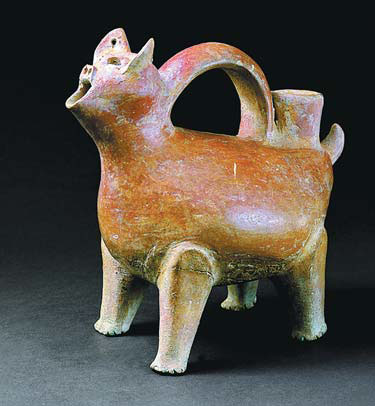
Dawenkou pottery was vividly molded and features various colors and patterns. One of its best-know types is a red-color zoomorphic pot.
The pot was unearthed in Taian city in 1959. Used as a water or food container, it is shaped like a pig, 21.6 cm tall and polished all over. The pig-shaped pot has thick and strong limbs with a short, upturned tail. It features a handle on its back and a filling tube near the tail.
The eggshell black pottery of the Longshan culture is as thin as paper but as hard as porcelain. It represents the highest skill of pottery making in China's prehistorical age.
Pictorial stones from the Han Dynasty (206 BC-AD 220) are architectural components of tombs, graveyard shrines and gate towers carved with portraits depicting life at that time, including funeral customs and religious beliefs. The art combines painting and sculpture skills.
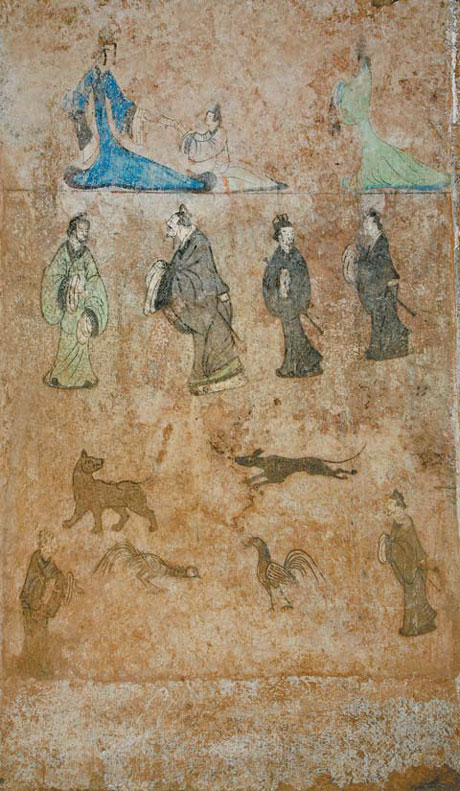
The pictorial stones in Shandong Museum are collected from across the province and the exhibits are known for both the quantity and high quality of its relics. In a mural unearthed from a Han Dynasty tomb in the Dongping area, details and colors can still be seen today.
Buddhist art, including statues and scrolls, make up another exhibition highlight in the museum.
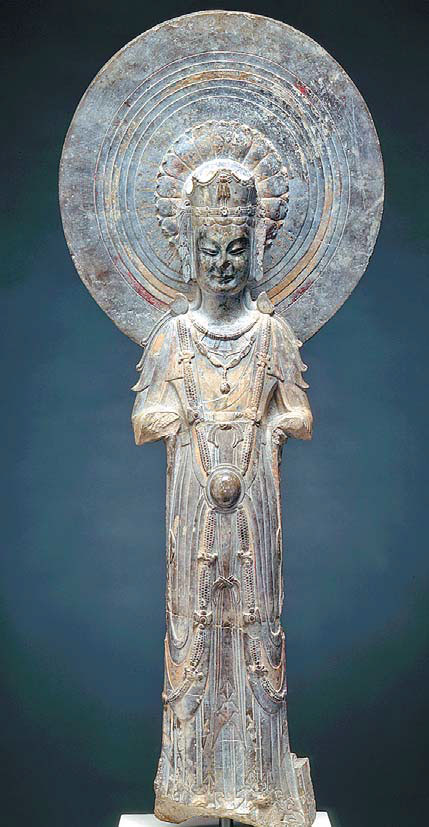
A statue from the Eastern Wei Dynasty (AD 534-550) shows a Bodhisattva wearing a headpiece decorated with a cicada. The type of headpiece had been used by officers in the imperial household of the Han Dynasty and in later dynasties became a symbol of high social status.
The Bodhisattva wearing such a headpiece is regarded as an embodiment of the localization of the Buddhist culture.
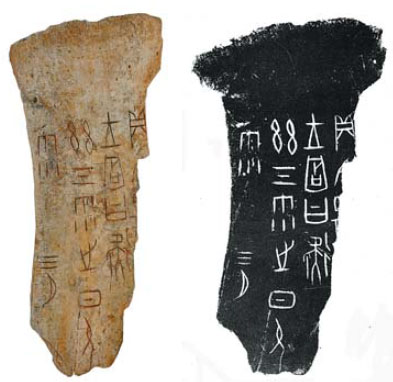
Oracle bone scripts, commonly known as jiaguwen, are inscriptions on animal bones or tortoise shells. The art form is the ancestor of the Chinese family of scripts and one of the earliest known writing systems in the world.
Mostly used for divination in the late Shang Dynasty (c.16th century-11th century BC), the inscriptions cover a wide range of content, including politics, religion, military affairs, economy and social activities. Studying the art has become an international science that has close relations with history, archaeology and linguistics.
Shandong Museum has a collection of more than 10,000 pieces of such scripts, which were unearthed from the Yin Ruins, the archaeological site of the capital of Shang. They were donated by a number of collectors worldwide.
One of the pieces, made of ox shoulder blade, still preserves the red color painted on thousands of years ago. The content of the script is about the king of Shang inquiring if it was going to rain. The character for rain is vividly inscribed like rain drops.
Bamboo slips were another main way to write in early China before paper was invented.
Shandong Museum discovered two tombs from the early Han Dynasty in 1972 in Linyi city, and found more than 7,600 bamboo slips, which are mainly about the Art of War.
Based on visitor votes and expert appraisals, the museum unveiled a list of its top 10 exhibits in 2011. They included those covering pottery, bronzeware, murals, clothing, Chinese paintings, oracle bone scripts and bamboo slips.
Contact the writer at zhangzhao@chinadaily.com.cn
|
A mural unearthed from a Han Dynasty tomb in the Dongping area, in which the details and colours can still be seen. |
|
A Bodhisattva statue wearing a headpiece decorated with a cicada that was built in the Eastern Wei Dynasty is regarded as an embodiment of the localization of the Buddhist culture. |
|
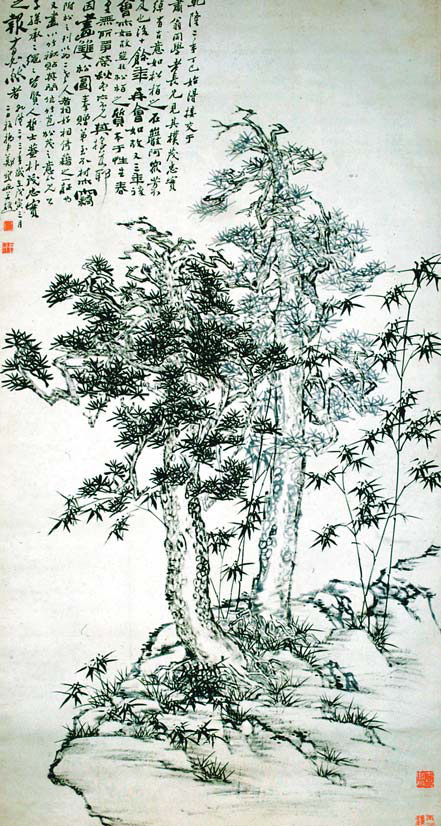
An ink painting by Zheng Xie (1693-1765), now on display in Shandong Museum. |
|
The red-color zoomorphic pot, a typical representation of Dawenkou pottery. |
|
A Ju Rectangle Ding, a bronze cooking vessel with two loop handles and four legs, from the Shang Dynasty. |
|
An oracle bone script (left), commonly known as jiaguwen, used for writing in the late Shang Dynasty. The content of the script is about the king of Shang inquiring if it was going to rain. The character for rain is vividly inscribed like rain drops. A rubbing of the original (right). |
|
A Dawenkou-style pot with octagon-shaped patterns. |
|
The eggshell black pottery cup from the Longshan culture is as thin as paper but as hard as porcelain. |
|
Youngsters get a taste of traditional culture in Shandong Museum. |
(China Daily 08/22/2015 page10)


Copyright 1995 - . All rights reserved. The content (including but not limited to text, photo, multimedia information, etc) published in this site belongs to China Daily Information Co (CDIC). Without written authorization from CDIC, such content shall not be republished or used in any form. Note: Browsers with 1024*768 or higher resolution are suggested for this site.
License for publishing multimedia online 0108263 Registration Number: 130349