City government is prioritizing land registrations and promoting family farms this year, Ding Congrong and Zhu Wenjun report.
Nantong in East China’s Jiangsu province is actively promoting family farms and rural cooperatives to develop its agricultural industries.
With increasing rates of urbanization in the city, more and more farmers have left their land and found jobs in urban areas.
According to a recent survey from the Nantong People’s Congress, the city now has 364,700 hectares of farmland, though nearly 70 percent of the rural labor force has shifted to non-agricultural industries.
And more than 80 percent of income for the rural labor force comes from non-agricultural industries.
The loss of farmers to other industries has raised concerns among city officials that fewer and fewer people are willing to grow crops in Nantong.
Currently, the city government is prioritizing the regulation of land transfers and promoting family farms as its key tasks this year.
For farmers, a major concern is the issue of land-use rights.
Shao Jinzhi, a 77-year-old farmer in the city’s Zhitian village in Shigang town, said the family’s small parcels of land have become a headache for him.
“All my children now work in the city,” said Shao, who added he is too old to handle the tiring farm labor on his own. “They can’t help with the plantation or harvest.”
Other farmers in the village, he said, face the same problem.
Fang Zhiqing, the village’s Party chief, said they are encouraging villagers like Shao to lease their land to others who have the ability to cultivate the land.
“But farmers are reluctant to do so because they are afraid they cannot get their land back, while others fear the land will be wasted once they lease it.”
Ding Zhiqiang, a deputy to the Nantong People’s Congress, said the farmers’ worries are justified because of disputes over land-use rights.
“A clear land-use right ownership is the precondition for any land transfer,” he said.
Under Chinese law, all land belongs to the country. Farmers have the land-use right, but the land can also be leased to others.
Haimen, a county-level city under Nantong, is among the country’s first batch of pilot cities to launch registrations for land-use right ownership.
The Nantong government aims to finish the registration work of its farmland by the end of 2016.
So far, more than 900 villages, or more than 60 percent of all villages in the city, have finished the registration work and villagers have received certificates that give them the right to use their land.
Yao Jie, an official from the agriculture bureau of Haimen, said the certificates could serve as a warranty for farmers.
“Once the ownership is confirmed, the proceeds from the land is decided,” he said. “Thus, farmers can safely lease their land to others.”
Farmer Xu Fang of Shizong town recently leased her land, which is part of a large vegetable plantation operated by a large agricultural company.
Xu now gets 1,000 yuan ($157) a month in rent for her land. She also earns 60 yuan per day by working at the plantation.
“I don’t need to worry about how to grow my land and also can get rent payments each month. It is a good thing,” she said.
Fang, the village’s Party chief, said more and more people from the village are seeing benefits from leasing their land.
By the end of June this year, nearly half of the land in Nantong had been transferred.
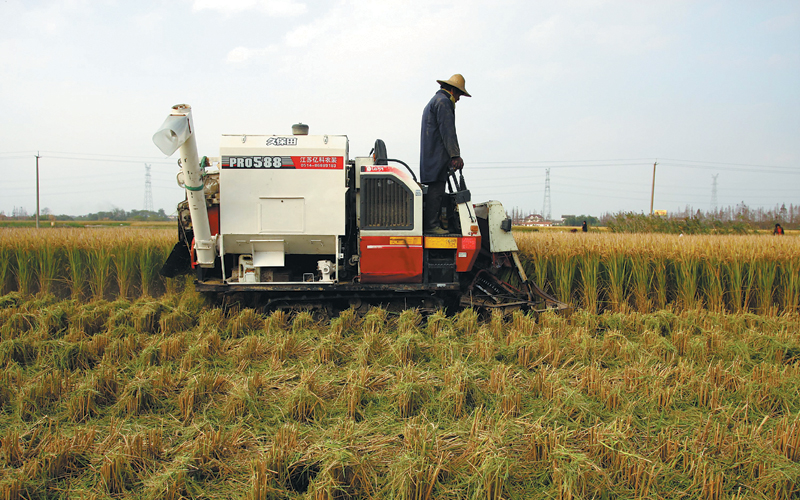
Governments of various levels in Nantong have also rolled out a series of policies to encourage people to lease their land together to form a large patch of land to make it suitable for large-scale machinery operations.
Sun Hongjian, head of a agricultural cooperative in Shigang town, said the cooperative currently has more than 560 hectares under its “custody”.
“The land all comes from hundreds of individual farms, who entrust their land to us,” he said. “From plantation to harvest, we use machines, which has greatly enhanced efficiency.”
Sun said they now can also sell the harvest together, which gives them more bargaining power with market buyers.
Besides rural cooperatives, family farms are also becoming more popular in the countryside.
Cao Rong and his wife Sun Chunmei left their jobs in Nanjing and returned to their hometown of Dongshe town in Nantong in 2005.
The couple leased 5 hectares of land and opened a farm to grow organic fruits and vegetables.
They sell their products online and now regularly deliver fruits and vegetables to urban dwellers.
They said urban residents have recently booked tours of their farm.
Thanks to the technical support from the local government, Sun said they can now expand the farm to make a higher profit.
There are currently more than 2,800 family farms of various sizes in Nantong, according to city government statistics.
Contact the writers through dingcongrong@chinadaily.com.cn


Copyright 1995 - . All rights reserved. The content (including but not limited to text, photo, multimedia information, etc) published in this site belongs to China Daily Information Co (CDIC). Without written authorization from CDIC, such content shall not be republished or used in any form. Note: Browsers with 1024*768 or higher resolution are suggested for this site.
License for publishing multimedia online 0108263 Registration Number: 130349