Geographical advantages
Harbin boasts one of the world’s three black lands that are suitable for rice planting. Thanks to the fertile soil, abundant sunshine and rain, Harbin has managed to develop a unique rice brand known to the whole of China.
The depth of Harbin’s black soil ranges from 40 to 100 centimeters, with rich organic matter resulting from the rotting of a large amount of leaves for thousands of years. Located at a northern latitude of 45 degrees, Harbin has four distinct seasons with big diurnal temperature variations, conditions that are beneficial to producing nutritionally rich rice.
Statistics reveal that the amount of precipitation in Harbin throughout the year ranges from 400 to 900 millimeters. Also, the Songhua River and its tributaries offer pollution-free irrigation water for the rice in Harbin.
So far, Harbin has developed over 10 areas along the rivers as key bases for rice production.
Varieties
After years of effort, Harbin scientific establishments have developed various quality varieties of rice that are cold and disease resistant and of high yield, such as Songgeng No18 and Wuyou No 4.
In 2006, Yuan Longping, known as the father of hybrid rice in China, once said Harbin rice was superior to rice produced in Japan, the country of rice, in terms of quality and yield.
In addition, technology is also a guarantee of the quality of Harbin rice. Depending on the ecological environment in different regions of Harbin, scientists have developed different brands that are tailored for each specific region. Wuchang in Harbin is famous for the brand Daohuaxiang; Fangzheng is home to japonica rice with rich selenium content, and Yanshou county is the birthplace of fragrant rice.
Cultivation techniques
China Grain Sector Association says that the advanced technique featuring dry breeding and scattered planting is applied to the plantation of Harbin rice. Technical innovation makes it possible to draw on the advantages of rice in Japan and combine them with that of Harbin’s rice.
Besides, Harbin’s low temperature serves as a natural pesticide, reducing the possibility for the rice to be infected with diseases. Statistics reveal that the amount of chemical fertilizer and pesticides used on rice fields in Harbin is the lowest on average in a year across the country, and the heavy metal content in crops in Harbin is far less than the national standard.
In 2016, the total area of rice planting in Harbin amounted to 935 mu, with a total output of 5.2 million tons.
Storage and processing
Statistics reveal that there were 517 rice-processing firms in Harbin by the end of 2016, with annual processing volume of 18.7 million tonnes, accounting for 41 percent of the total in North China’s Heilongjiang province.
Besides, Harbin is developing proficiency in rice storage to ensure the quality of the product. According to the research, Harbin is now home to 1,378 grain corporations with total storage of 17.58 million tonnes of rice.
There are now eight grain business parks that can process over 3 million tonnes of rice a year. Harbin is also developing several State-owned corporations to further improve its rice storage. The city is now the largest rice warehouse among all provincial capitals.
There are five railways that connect Harbin to other parts of the province and the country, ensuring the widespread and fast circulation of the rice.
Statistics revealed by the Inspection and Quarantine Bureau of Harbin showed that 74,000 tonnes of rice had been exported by Aug 16, 2017, up 204.2 percent year-on-year. The total value of exported rice amounted to $23.6 million, up 105.4 percent from the same period last year.
Harbin has now developed a thorough sales network with agents and partners all over the country. From 2014 to 2016, total sales of rice reached 24 billion yuan ($3.65 billion) with annual sales volume of 4 million tonnes.
Marketing system
Harbin has adopted a new marketing strategy with internet as the platform to promote Harbin rice. On Mar 25, 2017, Heilongjiang province built an on-line auction platform where 600 tons of Wuchang rice (a rice variety produced in Wuchang, Harbin) was sold at a price of 4.8 million yuan ($729,250). Internet marketing not only helps increase the sales volume of Harbin rice but also makes it even more famous. Harbin rice is stepping into a virtuous circle.
In 2016, the List for Chinese Brands Value Evaluation revealed that Wuchang Rice ranked second place among China’s agricultural brands at a value of 63.9 billion yuan ($9.71 billion); Fangzheng Rice (rice produced in Fangzheng county) was ranked 19th at a value of 8.94 billion yuan; while Tonghe Rice (rice produced in Tonghe) placed 20th at a value of 8.32 billion yuan.
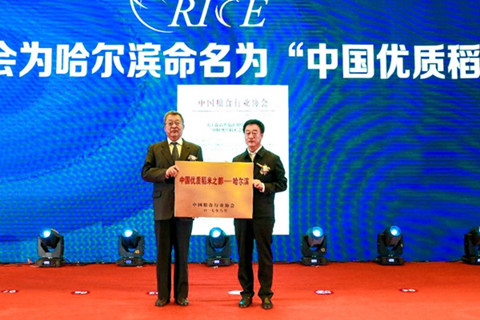
All these varieties make Harbin a capital city of rice in China.