SHOWBIZ> Hot Pot Column

|
SHOWBIZ> Hot Pot Column
|
|
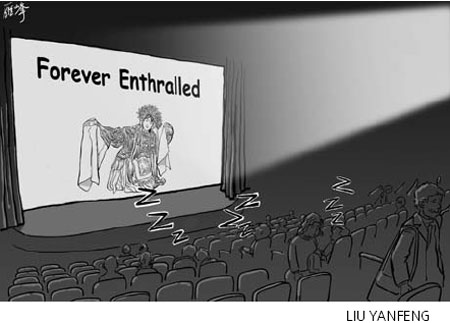
Peking Opera master's story fails to enthrall
By Qin Xiaoying (China Daily)
Updated: 2008-12-29 11:10 After watching Forever Enthralled, a biopic about the life of renowned Peking Opera artist Mei Lanfang, I couldn't help but wonder why such an intriguing subject had been handled with such blandness and mediocrity. The late master Mei was known for developing the performance of female characters in Peking Opera, making innovations to adapt the opera to the times and promoting it abroad by touring Japan, the former Soviet Union, and the United States. Mei has long been a legend among Peking Opera lovers for his impeccable techniques, integrity, charisma, and lifelong devotion to the art. He is a gorgeous figure full of stories through which the history of Peking Opera is shown in personal light. An interesting subject as it is, Chen Kaige-directed Forever Enthralled fails to develop it into an equally poignant story. In fact, the second half of the movie drags. And the main character lacks vitality. Several critics and movie buffs believe casting Leon Lai as Mei was a wrong choice to begin with. But I think the problem lies with the director's misconception of Mei and his pursuit of arts. First, the director has misinterpreted Mei's disposition. Mei is wrongly depicted in the movie as a lonely and introverted man. On the contrary, in reality, he was cheerful, smart and quite sociable. As a famed artist, he respected his teachers and loved his students. And he always stood above parochial prejudice. He studied the techniques and styles of other Peking Opera stars, as well as those of other major local operas and incorporated some of the elements into his own performance for better effect. He also had many hobbies besides singing, and had befriended many people out of the opera circle, some of whom gave him financial support, including sponsoring his overseas visits. Traveling abroad helped him get a broad outlook of the world, and take bold steps to innovate Peking Opera in terms of scripts, music accompaniment, techniques, costumes and facial makeup.
Second, the movie leaves a lot to be desired while revealing Mei's patriotism. During the War against Japanese Aggression (1937-45), Mei had tried every means to avoid performing for the invaders. He moved with his family to Hong Kong in 1938 to escape from the harassment and intimidation of the Japanese in Shanghai. In Hong Kong, he performed opera with patriotic themes to boost the morale of Chinese soldiers. In 1941, when Hong Kong, too was invaded, he began sporting a moustache to deliberately make himself unfit to appear on stage. He had explicitly stated he would commit suicide if it shall be the only way he could escape the Japanese. In the years when he stopped acting, he supported his family and his friends by painting and selling his works. Mei's life was a demonstration of the artist's principle: Art knows no boundaries, but the artist loves his own country. Unfortunately, the movie falls short of developing on this very important aspect of Mei's life. Third, the director has imposed a set of "paper shackles" on Mei, which certainly do not belong to the artist. Mei had immensely loved Peking Opera and created a distinctive performing system that has formed a crucial part of the Chinese theater arts. He was indeed a devoted artist who had been driven by an intense love toward the opera. However, in the movie, the director tries to make the audience believe Mei was actually wearing "paper shackles" - fame, burden of his family, pressure from his fans and supporters, and other worldly considerations - which forced him to make progress and make choices.
Here, he is portrayed as a man living a life that is not his choice, and is too weak to break the shackles. Director Chen is very fond of this motif of "paper shackles". Yet, this set of shackles should have suited Chen himself better, since the director has till now failed to make a movie that could rival Farewell, My Concubine, which won him accolades at home and abroad 15 years ago. As far as Mei is concerned, he was never confined to such shackles. Last, the movie portrays Mei as an artist who is living an aristocratic life. Yet, he was far from holding himself aloof above the ordinary people. It reminds me of a story. In 1959, when the Great Hall of the People was completed, a performance was planned to reward the builders and technicians. When asked what they would like to watch, their first choice was to see Mei perform on stage. And whenever Mei made innovative moves in his techniques, he would ask his aides to collect feedback from the audience to see if they were well received. He would make adjustments based on audience opinions. It shows Mei is an artist of the people - he is popular among the people and his performances are for the people. The movie may satisfy the curiosity of young people who are not familiar with Peking Opera, or foreigners who've heard about it for the first time. It can also help them get acquainted with this traditional art. However, to those who are deeply in love with the national treasure, the movie has failed to live up to their expectations because it is incapable of telling a complete and compelling story. It is incompetent of portraying Mei as a man of blood and flesh, and a man of integrity and courage. I wonder why - is it because Chen is too highflying to come out with a product with substance in a down-to-earth manner? Or is it because his particular artistic pursuit has prevented him from observing a historical figure from a proper angle? It is really a pity that this subject - so intriguing and compelling - has been developed into such a colorless and lukewarm film. The author is a researcher with the China Foundation for International and Strategic Studies |
主站蜘蛛池模板: 青浦区| 永善县| 岳普湖县| 梨树县| 阿克| 浦城县| 铜川市| 山阴县| 思茅市| 正宁县| 嘉荫县| 周宁县| 无锡市| 同心县| 延长县| 会泽县| 赤水市| 西青区| 巫溪县| 交口县| 全州县| 香河县| 如皋市| 延吉市| 崇州市| 夏河县| 应用必备| 山西省| 乌恰县| 定安县| 慈利县| 和平县| 绥滨县| 江油市| 湘乡市| 乌兰察布市| 醴陵市| 通州区| 依兰县| 德格县| 双鸭山市| 遂昌县| 临桂县| 泸西县| 额济纳旗| 襄汾县| 凤山市| 资溪县| 鄂托克前旗| 周宁县| 河东区| 木里| 南城县| 磐安县| 离岛区| 嘉峪关市| 南昌县| 灵台县| 建湖县| 天等县| 金沙县| 龙井市| 莒南县| 曲水县| 辽阳市| 贵溪市| 信阳市| 丹江口市| 饶平县| 中江县| 嘉禾县| 都昌县| 萍乡市| 英超| 郧西县| 依安县| 百色市| 连江县| 洛南县| 马公市| 高要市| 海口市|