 |
|
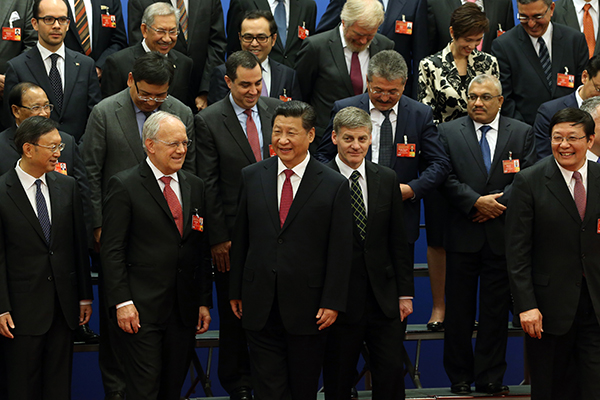
President Xi Jinping joins with envoys of governments that signed onto the Chinese-led Asian Infrastructure Investment Bank at the Great Hall of the People in Beijing on June. [Photo/China Daily] |
For years, the G7 nations have pledged substantial governance reforms in international multilateral institutions, such as the International Monetary Fund, the World Bank and the Asian Development Bank. But the promises have been left unfulfilled, not least because these organizations are dominated by American, European and Japanese interests, as reflected by their voting quotas, investment allocations and the nationalities of their leaders.
In this context, the China-proposed Asian Infrastructure Investment Bank represents the needs of emerging economies which have been failed by the international multilateral institutions that were created and remain frozen in the mid-1940s.
In the fall of 2013, Chinese leaders proposed the establishment of the AIIB. In June 2014, they proposed doubling the registered capital of the bank from $50 billion to $100 billion, with nearly 30 percent of that coming from Beijing and the rest from the other founding members. Overall, some 75 percent of the AIIB's capital and voting rights are likely to be Asian.
The establishment of the AIIB on June 29 means an urgent response to a massive infrastructure need. Neither the World Bank nor the ADB has the funds to drive infrastructure progress in Asia.
According to the ADB, Asia's economic development needs about $8 trillion from 2010 to 2020 to ensure the success of the "Asian century." That would allow an additional 3 billion Asians to enjoy living standards that are closer to those in Europe today. In turn, Asia would account for more than half of the global output by 2050.
In the absence of dependable sources of massive infrastructure investments, the "Asian century" will remain a pipedream, however. Hence the need for the AIIB.
Unlike the ADB, which restricts contracts to member countries, the AIIB will open bidding for projects to all. In this sense, the importance of the AIIB will extend far beyond China's "Belt and Road Initiative", which is regional but will have positive spillover effects across the world.
Despite the US' initial opposition, its allies in East and Southeast Asia joined the AIIB. Following in the footprints of India and Russia so did the rest of the countries in South Asia, and Oceania, Central Asia, and much of the Middle East and Latin America.
The AIIB is not a rival to existing multilateral financial institutions. Rather, it will complement them, as suggested by the Japanese, US and European heads of the ADB, the World Bank and the IMF, respectively. AIIB critics have argued that it would not meet environmental standards, procurement requirements and other safeguards strictly followed by the World Bank and the ADB. In reality, the World Bank, the IMF and the ADB have been criticized for years for their lending rules, policies and staffing bias.
Over the past few years, the White House has seen the BRICS' New Development Bank as a potential threat to the existing multilateral organizations. It is pushing for a trans-Pacific trade bloc, which excludes China. And it has opposed the reserve currency status of the Chinese yuan. As a result, senior US figures have argued that Washington has mishandled its response to China's efforts to serve as a "responsible stakeholder" in the world economy. Among others, former secretary of Treasury Lawrence Summers has said the US cold-shouldering of the AIIB may be recalled as the moment America "lost its role as the underwriter of the global economic system".
US participation in the AIIB will be very much in the interest of American companies, cities and states, and Washington itself. It would mitigate the perception that the US seeks to "contain" China, or emerging Asia. And it would pave the way to greater stability and prosperity in Asia and the rest of the world.
The author is research director of International Business at India China and America Institute (US) and visiting fellow at Shanghai Institutes for International Studies (China) and the EU Centre (Singapore).
Related Stories
Copyright 1995 - . All rights reserved. The content (including but not limited to text, photo, multimedia information, etc) published in this site belongs to China Daily Information Co (CDIC). Without written authorization from CDIC, such content shall not be republished or used in any form. Note: Browsers with 1024*768 or higher resolution are suggested for this site.
License for publishing multimedia online 0108263 Registration Number: 130349