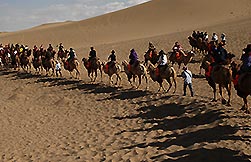
Europe has been slow to respond to China's Belt and Road Initiative, but this may be about to change. If both sides play their cards right, the European Union-China Summit on June 29 could kick-start a much needed conversation on synergies between China's ambitious vision of an interconnected world and Europe's large investment plan to boost jobs and growth.
The rewards of such cooperation could be enormous. Increased connectivity between China and the EU will increase bilateral trade, create business opportunities for European and Chinese enterprises, and boost employment, growth and development in both countries-and in countries along the proposed routes.
To start the dialogue, Europeans will have to take the long view. With the possibility of a Greek exit from the eurozone getting ever closer, United Kingdom's plans for a referendum on its EU membership becoming more strident, and growing discord over how to deal with the refugee crisis, European policymakers are thinking local, not global.
It's not just about domestic difficulties. Europe's neighborhood is on fire.
And yet, if Europe is to fulfill its ambitions of becoming a global actor, while also meeting the domestic imperative of generating stronger economic growth and creating jobs, EU policymakers must look beyond the current emergencies to Europe's medium-to long-term needs.
This is the logic behind the 315 billion euro ($350 billion) investment plan drawn up by European Commission President Jean Claude Juncker to modernize Europe's infrastructure. With its focus on investments in energy, digital, transport and innovation, the blueprint has the potential to revitalize European economies over the next decade.
But Europe can't possibly do it alone. This is why it is important that EU governments, business leaders and academics start paying more attention to China's headline-grabbing Belt and Road Initiative, and ways in which this could fit in with the EU's investment master plan.
After months of staying relatively silent on the subject, EU policymakers are beginning to talk about-and explore-the advantages of synergies between the Juncker plan and the initiative, which relates to the proposed Silk Road Economic Belt and the 21st Century Maritime Silk Road.
Clearly, joining forces will unleash more resources. Implementing the EU investment plan will require the mobilization of billions of euros of private and public funds aswell as capital from the European Investment Bank. EC Vice-President Jyrki Katainen said the EU is hoping to attract Chinese investors to stump up capital for the Juncker plan. The point has also been made by European Trade Commissioner Cecilia Malmstrom and the EC president.
The hope is that EU connectivity projects will be able to interest both the Silk Road Fund and the Asian Infrastructure Investment Bank. The EU is particularly interested in meeting the long-term infrastructure needs in southern, eastern and central European countries and in the Balkan states. Greece, as well as some members of the so-called 16+1 group of central and eastern European countries, have already indicated strong interest in such Chinese investment. If all goes according to plan, the eastern part of Europe could connect seamlessly with the western projects on the new Silk Road.
As the different Belt and Road projects come on stream, business opportunities will open along the route for construction, transport and logistical companies, including European enterprises. EU-China trade is likely to get an important boost from the expected reduction in transport time and costs, while EU exporters and investors will gain access to new growth markets in inland China and Central Asia.
Such a development would be a fillip to EU-China negotiations on a bilateral investment treaty.
As it passes through often-volatile and less-developed countries and regions, the Belt and Road Initiative has the potential to unleash economic potential along the way, bringing stability and growth to Europe's neighborhood, and China's. Such a conversation could be especially useful within the 53-member Asia Europe Meeting, where connectivity is also climbing up the agenda.
It's not just about money, technology and good will, however. The EU insists that investment projects selected for financing under the Belt and Road Initiative must meet strict governance, environmental and technical standards, and result in sustainable development.
Moving from dialogue to action will require time and effort, and willingness to compromise. China has taken its time in putting flesh on the bones of the project and in explaining its many facets to a closely watching world. A more detailed dialogue is necessary before the EU and China get down to identifying and working on the nuts and bolts of their cooperation. Given their different working methods and cultures, European and Chinese policymakers, bankers and business leaders won't find it easy to work together. The devil will certainly be in the details. Expectations will have to be managed on both sides.
The author is policy director for Friends of Europe, a think tank in Brussels. The views do not necessarily reflect those of China Daily.
Related Stories
Copyright 1995 - . All rights reserved. The content (including but not limited to text, photo, multimedia information, etc) published in this site belongs to China Daily Information Co (CDIC). Without written authorization from CDIC, such content shall not be republished or used in any form. Note: Browsers with 1024*768 or higher resolution are suggested for this site.
License for publishing multimedia online 0108263 Registration Number: 130349