Carbon offers clues to die-off
Updated: 2012-05-13 07:48
By Alanna Mitchell(The New York Times)
|
|||||||


|
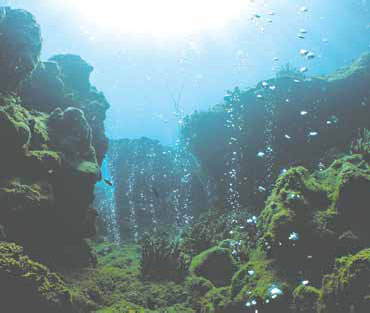
In the Great Dying 252 million years ago, about 95 percent of marine species were wiped out. Katharina Fabricius / Australian Institute of Marine Science |
It may never be as well known as the Cretaceous extinction, the one that killed off the dinosaurs. Yet the much earlier Permian extinction - 252 million years ago - was by far the most catastrophic of the planet's five known paroxysms of species loss.
No wonder it is called the Great Dying: scientists calculate that about 95 percent of marine species, and an uncountable but probably comparable percentage of land species, went extinct in a geological heartbeat.
The cause or causes remain a mystery. Among the hypotheses are a devastating asteroid strike, as in the Cretaceous extinction; a catastrophic volcanic eruption; and a welling-up of oxygen-depleted water from the depths of the oceans. Now, analyses of fossils point to a different way to think about the problem.
Scientists from Stanford University and the University of California, Santa Cruz, adopted a cellular approach, considering instead what happened within the animals' cells to finish them off.
After analyzing fossils from the period, Matthew E. Clapham, an earth scientist at Santa Cruz, and Jonathan L. Payne, a Stanford geochemist, concluded that animals with skeletons or shells made of calcium carbonate were more likely to die than those with skeletons of other substances. And animals that had few ways of protecting their internal chemistry were more apt to disappear.
The scientists concluded that the animals died from a lack of dissolved oxygen in the water, an excess of carbon dioxide, a reduced ability to make shells from calcium carbonate, altered ocean acidity and higher water temperatures. The result was a wholesale change in the ocean's dominant animals within just 200,000 years, or less, Dr. Clapham said.
Among the hardest hit were corals; and every species of trilobites, with their helmetlike front shells, vanished. Instead, gastropods like snails and bivalves like clams and scallops became the dominant creatures. And that shift led directly to the assemblage of life in today's oceans. "Modern marine ecology is shaped by the extinction spasms of the past," Dr. Clapham said.
So what had happened to cause those physiological stresses? The scientists concluded it had been a huge infusion of carbon into the atmosphere and the ocean. But neither an asteroid strike nor an upwelling of oxygen-deprived deep-ocean water would explain the selective pattern of death.
The scientists suspect that the answer lies in the biggest volcanic event of the past 500 million years - the eruptions that formed the Siberian Traps, the stairlike hilly region in northern Russia. Catastrophic amounts of carbon gas were sent into the atmosphere, leading to ocean acidification, ocean warming and vast areas of oxygen-poor ocean water.
Dr. Clapham was surprised by how closely the findings matched today's trends in ocean chemistry.
Andrew H. Knoll, a Harvard University geologist who wrote a seminal 1996 paper exploring the consequences of a rapid increase in carbon dioxide in the atmosphere on organisms, said, "What we're seeing now and what is predicted in the next two centuries is riding a parallel track to what we think happened in the past."
Noting that the similarities are not exact, Dr. Clapham said that corals are the most vulnerable creatures in the modern ocean for the same reason they were during the Permian extinction. They have little ability to govern their internal chemistry and they rely on calcium carbonate.
Hans Portner, an animal ecophysiologist at the Alfred Wegener Institute in Bremerhaven, Germany, also cautioned that the trends between the two periods were not exactly comparable, but noted that carbon was being injected into the atmosphere today far faster than during the Permian extinction.
As Dr. Knoll put it, "Today, humans turn out to be every bit as good as volcanoes at putting carbon dioxide into the atmosphere."
The New York Times
(China Daily 05/13/2012 page11)